Do Dog Cooling Mats Work in the Car? Gel vs Water vs Fabric Tested
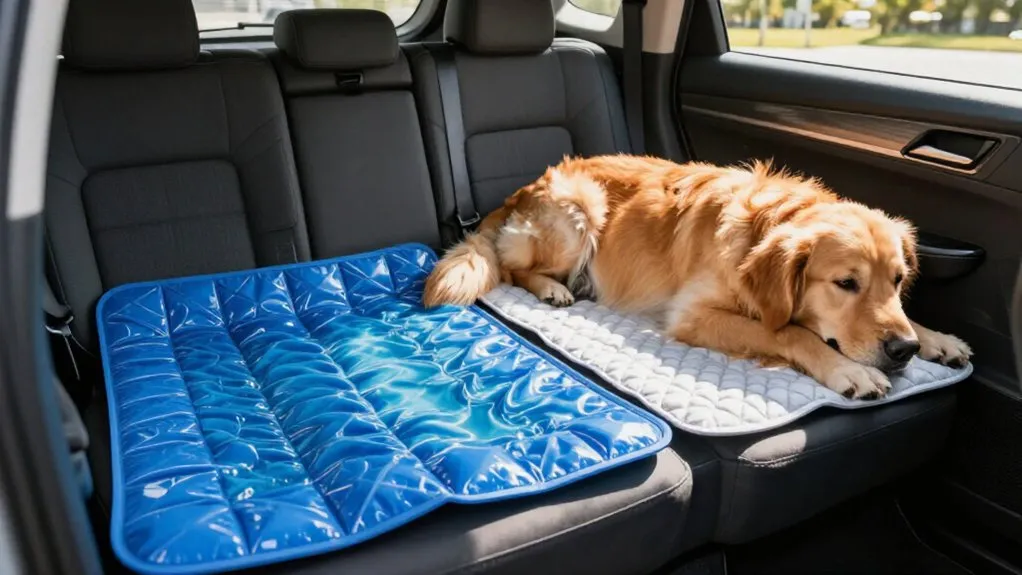
Dog cooling mats can improve your dog’s comfort in an air-conditioned car, but they won’t make a hot parked vehicle safe.
Gel pads offer brief contact cooling for hours, while cool water pads generally last longer. Wet fabric and elevated mesh need airflow, so they work poorly in stagnant cabins.
Direct sun and heat can overwhelm any mat within minutes. Keep bedding off passive mats and check hot surfaces; the details below explain safer use.
Cooling Mats Offer Limited Relief
Dog cooling mats can provide short-term comfort in a car, but they can’t control the dangerous heat buildup inside a parked vehicle. You can use a pressure-activated gel mat for portable, contact-based relief: it typically begins about 10 to 15°F below ambient temperature and may feel cool for roughly three to four hours under favorable conditions. A pre-chilled water-filled pad offers greater thermal mass and can last six to eight hours, but requires filling, transport, and cleaning. Wet fabric mats need airflow and low enough humidity to evaporate effectively.
Elevated mesh beds improve air circulation beneath your dog when ventilation is available. Inspect any mat for punctures, leaks, or chewing damage, and don’t freeze gel products. Choose supportive water beds for older dogs, but treat mats as comfort accessories, not safety systems.
Car Cabin Heat Overwhelms Mats
That limited relief disappears quickly when cabin heat rises. A mat can absorb heat only while it remains cooler than your dog and its surroundings. In a sun-exposed, closed vehicle, cabin air and seat surfaces gain heat continuously, so passive materials approach the same temperature instead of removing heat.
Gel pads offer a cool contact surface, but thin gel warms rapidly under solar loading. Water-filled pads provide thermal buffering, especially when filled with cool water, yet cabin heat eventually warms the water. Ice-silk and fabric mats contain no cold reservoir; they conduct heat briefly, then equilibrate with the cabin.
While driving, air conditioning and airflow may support a mat’s comfort role. When parked in heat, none provides heatstroke protection; don’t leave your dog unattended.
After 20 Minutes Parked
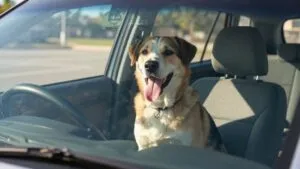
Within 20 minutes of parking in warm sun, a car’s interior can heat enough to overwhelm a cooling mat’s limited thermal reserve. At this point, surface readings may no longer reflect the mat’s starting temperature; they increasingly track the hot cabin, sunlit upholstery, and your dog’s body heat. A thin pad can warm rapidly under direct solar exposure.
You shouldn’t use a mat as justification to leave your dog parked and unattended. Water-filled designs with cool water may buffer heat longer, but they can’t control the greenhouse-driven rise in cabin temperature. Wet fabric loses most evaporative benefit without airflow, while elevated fabric only helps if ventilation persists. Move your dog to air-conditioned shelter; watch for rapid panting, distress, weakness, or collapse, and seek veterinary care.
Pressure-Activated Gel Pads
Pressure-activated gel pads cool when your dog’s body weight engages a non-toxic gel that absorbs and disperses heat without power or preparation. In a car, they may provide an initial cooler surface for several hours, but cabin heat and direct sun can rapidly reduce that benefit. You shouldn’t treat a gel pad as protection against heatstroke or leave your dog unattended in a hot vehicle.
How Gel Pads Activate
When your dog lies on a gel cooling pad, its body weight activates the non-toxic gel layer, which absorbs and disperses heat from the contact areas without water, electricity, or prior chilling.
Pressure does not create cold or lower your dog’s core temperature; it improves close contact between the body and the pad’s heat-absorbing material. As warmth moves from skin and coat into the gel, it spreads that heat across a broader surface, reducing localized warmth.
You don’t need to soak, plug in, or refrigerate the mat. Use it only alongside shade, ventilation, and air conditioning. Inspect seams, prevent chewing, and remove a punctured pad promptly. Follow manufacturer instructions, because covers vary. A cooling pad cannot make a hot vehicle safe for your dog.
Cooling Duration In Cars
In a car, a pressure-activated gel pad’s cooling effect is temporary and declines faster as the cabin warms. You’ll usually notice the greatest surface-temperature reduction immediately after your dog lies down: consumer tests report roughly 10 to 15°F below ambient initially and about three to four hours of useful cooling under moderate conditions. Vehicle heat, sun-exposed upholstery, and repeated body contact accelerate equilibration, so duration can be substantially shorter.
| Observation | Expected pattern |
|---|---|
| Initial contact | Strongest effect |
| Continued use | Gradual warming |
| Warm cabin | Shorter duration |
| Rest period | Partial recharge |
To assess performance, touch the mat’s uncovered surface at intervals and watch whether your dog voluntarily remains on it. A 15 to 20-minute rest may restore cooling, but recovery varies with cabin conditions; it doesn’t recreate a chilled surface.
Heat And Safety Limits
Although a pressure-activated gel pad can provide brief contact cooling, it cannot control the dangerous heat buildup inside a parked car. Cabin temperatures can rise rapidly, while the pad’s finite gel layer absorbs heat only until it approaches cabin and body temperature. Direct sun can warm thin gel quickly, further reducing its effect.
You shouldn’t leave your dog unattended in a vehicle, even with windows cracked, shade, or a mat. These measures don’t provide reliable temperature control. Use active air-conditioning during travel and take your dog with you when you park. Watch for heavy panting, drooling, weakness, vomiting, confusion, or collapse. Move your dog to a cool, ventilated area and seek urgent veterinary care if heatstroke is suspected. Mats are secondary aids.
Dog Coat Thickness
Your dog’s coat thickness affects how efficiently a cooling mat can draw heat from the body, with double-coated breeds often retaining more heat near the skin. Short-coated dogs may transfer heat to the mat more readily, but they can still overheat rapidly in a hot car. Maintain appropriate grooming, without shaving double coats, and use climate control rather than relying on any mat for heat safety.
Double-Coated Breeds
Double-coated breeds, such as Huskies, Malamutes, and German Shepherds, may show a noticeable surface-temperature difference when they lie on a cooling mat, but their dense undercoat also limits how quickly cooling reaches the body. You shouldn’t interpret a cooler coat surface as evidence that your dog’s core temperature has fallen. In a car, passive gel, water, and fabric mats remove heat mainly at contact points, while the insulating coat slows transfer inward.
A pre-chilled water-filled mat may provide longer thermal buffering than thin gel, but it can’t offset rapid cabin warming. Wet fabric also performs poorly without airflow. Monitor panting, drooling, weakness, or distress, and use air conditioning or remove your dog immediately. Never leave a double-coated dog unattended in a vehicle, even with a mat.
Short-Coat Heat Retention
Short-coated dogs may transfer heat to a mat more readily than heavily insulated breeds because less fur separates the skin from the cooling surface. In practice, you may see faster contact cooling when your dog lies on a gel or water-filled pad, rather than touching it briefly.
This does not mean the mat removes dangerous body heat fast enough to protect your dog in a hot car. Passive pads absorb only a limited amount of heat and warm as the cabin temperature rises. Water-filled designs, especially when prepared with cool water, generally provide greater thermal buffering than thin gel mats. Evaporative fabric needs airflow, so it performs poorly in a closed vehicle. Watch for panting, distress, weakness, or altered behavior, and use air conditioning.
Grooming and Cooling Efficiency
Coat thickness changes how efficiently a cooling mat can draw heat from your dog: dense undercoats create an insulating barrier, while shorter or thinner coats allow better contact cooling.
Regular brushing removes loose undercoat and improves mat-to-coat contact, but it won’t make a parked car safe. Don’t shave a double-coated dog solely to improve cooling; the coat also limits solar heat gain and protects skin.
For thick-coated dogs, choose a mat as supplemental comfort, not heatstroke prevention. A pre-chilled water-fill pad may provide longer thermal buffering than gel, but cabin heat can overwhelm either type. Wet fabric needs airflow and performs poorly in a closed vehicle. Groom before travel, keep your dog conditioned, provide active climate control, and never leave them unattended in heat.
Air-Conditioned Road Trip Use
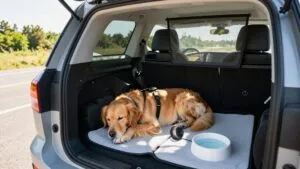
On an air-conditioned road trip, a cooling mat can improve your dog’s comfort by drawing heat away from the body or increasing airflow beneath it, but it shouldn’t replace proper cabin temperature control. Keep cabin cool, ventilated, and stable, then place the mat in a secured crate or on a non-slip seat cover. A gel mat offers contact cooling, but it warms as your dog rests. A pre-chilled water mat provides longer buffering; an elevated mesh mat works only when air can circulate beneath it.
Check your dog for panting, drooling, weakness, or reluctance to settle. Prevent chewing and punctures, and don’t let bedding interfere with restraints properly.
| Mat type | Best use |
|---|---|
| Gel | Short stops; monitor comfort |
| Water or mesh | Longer rides; secure it |
Direct Sunlight Negates Cooling
Direct sunlight can rapidly erase a cooling mat’s benefit inside a vehicle. Solar radiation heats the mat’s surface and raises the cabin’s overall temperature, so the heat it absorbs from your dog has nowhere useful to go. In testing, thin gel mats exposed to sun warmed substantially within 15 to 30 minutes, shortening their effective cooling period.
Water-filled pads offer greater thermal mass and may resist this warming longer, especially when started cool, but they still equilibrate as the car gains heat. Evaporative fabric also performs poorly when sunlight coincides with stagnant air. Keep your dog out of direct sun and use active air-conditioning during travel. Never treat shade alone or any passive mat as protection for an unattended dog in a parked vehicle in heat.
Towels Block Mat Cooling
A towel placed over a cooling mat insulates the surface and reduces the heat transfer that makes the mat work. Gel and water mats cool chiefly through direct contact; a dry, thick towel traps a layer of still air, slowing heat movement from your dog into the cooler material. A damp towel may feel cool initially, but in a car its evaporation depends on airflow and humidity, so it isn’t a dependable substitute.
- Bare mat: your dog contacts the coolest available surface.
- Thin cover: cooling reaches the coat more slowly.
- Folded bath towel: insulation substantially limits contact cooling.
- Wet towel: adds moisture without reliable evaporative benefit in stagnant air.
Use approved covers only. Keep bedding off mats; passive mats don’t make hot cars safe.
Check Paw Temperature Before Loading
Before you load your dog, press the back of your hand to the pavement and the car’s entry surface for several seconds; if either feels uncomfortably hot to you, it can burn paw pads.
Heat injury can occur before your dog reaches a cooling mat, especially when sun heats asphalt, metal thresholds, or plastic trim. Check surfaces in direct sun and shade, since conditions vary across a parking area.
If a surface is hot, carry your dog, choose shade, or wait. Don’t assume gel, water, or fabric mats protect feet during loading; they help after contact and have limited capacity. Inspect paws for limping, lifting, redness, or blisters. If you suspect a burn, stop exposure, cool paws with room-temperature water, and contact your veterinarian.
Conclusion
Cooling mats can improve short-term comfort, but you shouldn’t treat them as protection against vehicle heat. Gel, water, and fabric mats lose effectiveness as cabin temperatures rise, especially in sunlight or beneath towels. Use a mat only alongside active air-conditioning, shade, ventilation, and frequent temperature checks.
Before loading your dog, test the seating surface with your hand and check paw comfort. Never leave your dog parked unattended; within 20 minutes, heat can overwhelm any mat.