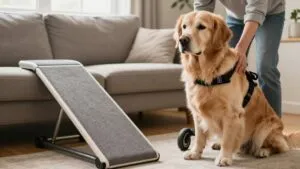
Dog Ramp Length Chart: Ramp Length by Vehicle Height

Measure your vehicle’s cargo-floor height, then choose ramp length to keep the slope near 20 to 25°; keep it under 20° for arthritis, recovery, or short legs.
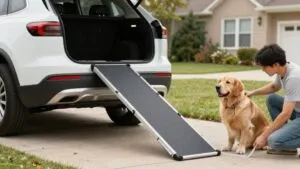
At a 24-inch entry, use 60 inches for roughly 22 to 23° or 72 inches for about 18°. At 30 inches, choose 72 inches minimum, preferably 88 inches or longer.
Provide 12 inches of clear deck width, secure traction, and ample weight capacity. The guidance below helps you match fit, grip, and stability.
Measure Tailgate Height First
Before choosing a ramp, measure the vertical distance from level ground to the exact point where your dog steps into the vehicle, usually the tailgate or cargo-floor edge. Park on level ground, set the parking brake, and measure straight upward with a tape measure; don’t follow the bumper’s curve or estimate from the tire. Record the height with the vehicle loaded as you normally travel, because passengers, cargo, and suspension settings can change it.
Measure the entry point, not the roofline or open hatch. This rise determines ramp slope and the forces your dog’s shoulders, hips, knees, and spine must control. A too-steep approach increases paw slip, joint loading, and hesitation, especially in seniors, arthritic dogs, and short-legged breeds. Recheck after tire or lift-kit changes.
Ramp Lengths for 30-Inch Tailgates
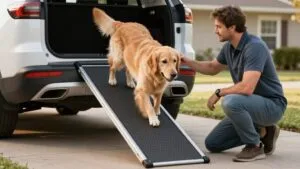
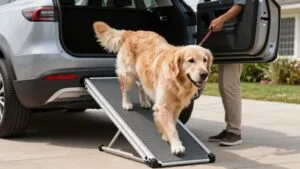
For a 30-inch tailgate, choose at least a 72-inch ramp for a roughly 25° approach, but aim for 88 inches or longer to keep the slope near 20°. A 30-inch rise challenges hips, knees, and paws, especially when your dog brakes while descending. Select a non-slip ramp with side rails, and confirm its weight rating exceeds your dog’s weight.
Longer models reduce joint loading and slipping risk, but add bulk. Measure storage dimensions before buying. For senior, arthritic, short-legged, or recovering dogs, prioritize 110 to 125 inches when space permits. Don’t rely on a 60 to 66-inch ramp at this height; its steepness can cause hesitation or jumps.
| Ramp length | Best fit |
|---|---|
| 60 to 66 in | Avoid: steep |
| 72 to 78 in | Healthy adult |
| 88 to 100 in | Senior/arthritis |
| 110 to 125 in | Maximum comfort |
Ramp Angle Measured in Degrees
Ramp angle puts ramp length into a practical safety measure: it shows how sharply your dog must climb and descend. Aim for 20 to 25° for a healthy adult during routine vehicle use; this range usually limits excessive hind-limb push-off and braking forces on descent. For seniors, arthritic dogs, short-legged breeds, or dogs recovering from injury, keep the angle below 20° when possible.
Calculate it from arctan(rise/run): rise is the vertical entry height, while run is the ramp’s ground-level horizontal distance. A 24-inch cargo height with a 60-inch ramp is about 22.6°; extending it to 72 inches lowers it to about 18.4°. Avoid angles over 30°, which raise slipping risk and can make a dog refuse the ramp. Confirm the ramp rests securely before every trip.
12-Inch Minimum Ramp Width
Choose a ramp with at least 12 inches of usable walking width so your dog can place its paws naturally without crowding the edges. Larger dogs need more width for stable balance and a comfortable gait, especially when climbing at an angle. Measure the clear surface between side rails, then confirm the ramp fits your vehicle’s entry area without reducing safe clearance.
Why 12 Inches Matters
A 12-inch minimum ramp width gives most dogs enough lateral room to place their paws naturally without crowding the edges, which can reduce hesitation and missteps. You should measure your dog’s stance at the shoulders and hips, then compare it with the usable, not advertised, walking surface. A narrow deck can force paws toward an edge, limiting normal weight shifts during ascent or descent.
That matters for dogs with reduced joint range, poor proprioception, or painful paws, because they may compensate with shorter, less secure steps. Twelve inches is a practical baseline, not a universal fit: dogs with broad chests, long strides, or mobility limitations may need more room. Choose a ramp whose grippy surface extends across its full usable width, then practice before use.
Stability for Larger Dogs
For larger dogs, target at least 16 inches of usable walking width, with 18 inches preferable for broad-chested or mobility-impaired breeds. A wider platform lets your dog place each paw naturally without crowding the edge. That matters because large dogs carry more load through their shoulders, elbows, hips, and stifles during ascent and descent.
Choose a ramp that stays rigid under your dog’s full weight and has secure vehicle contact, non-slip footing, and raised side protection where appropriate. Flexing or sideways movement can shift balance and make a dog hesitate, particularly if arthritis, weakness, or poor proprioception affects limb placement. Match the ramp’s weight rating to your dog, allowing a safety margin, and supervise initial practice sessions. A calm, straight approach reduces twisting and missteps.
Measuring Usable Ramp Width
Measure usable ramp width at the narrowest unobstructed walking surface, not the outside edge, rails, or folded frame, because your dog needs enough level, non-slip space to place paws naturally. For most adult dogs, choose at least 16 inches of usable width; 18 to 20 inches gives medium and large dogs a more secure paw-placement margin. Giant breeds, broad-chested dogs, and dogs with altered gait often need 20 to 24 inches or more.
Watch your dog walk: they should keep a natural stance, place each paw without twisting, and avoid stepping partly off the traction surface. Measure while the ramp is fully deployed; hinges, tapering, and textured inserts can reduce the true footing width. A narrow deck forces lateral paw placement and may increase missteps, especially when descending slowly.
Side Rails and Clearance
Side rails protect against side-steps, but they also reduce the effective walking deck, so base your minimum ramp-width choice on the clear space between the rails. Measure at the narrowest point, including tapered or inward-curving rail sections.
Your dog needs enough clearance to place each paw naturally, adjust balance, and avoid brushing hips or shoulders against the sides. For many dogs, at least 14 inches of clear deck suits small breeds; choose 16 inches or more for medium dogs and 18–20 inches for broad-chested, large breeds. These are practical starting points, not substitutes for measurement. Compare the clear deck with your dog’s shoulder width, then allow several inches for normal lateral sway. Rails should guide without catching limbs or letting anxious dogs step off.
Matching Width to Vehicles
Vehicle opening width sets a practical minimum ramp width: choose a ramp that fits securely on the cargo sill or door threshold while still providing adequate clear deck for your dog. Measure the narrowest usable opening, excluding trim that prevents contact, and compare it with the ramp’s supported end, not only its deck. For most dogs, select at least 16 inches of walking width; 18 to 20 inches better accommodates broad-chested, large-breed, or unsteady dogs.
A narrow deck can force paws near edges, reduce stride confidence, and increase lateral missteps, especially with arthritis or neurologic weakness. Make sure both ramp lips rest flat on vehicle structure without blocking hatch closure or slipping between surfaces. Don’t choose width alone: verify rails, non-slip tread, stiffness, and adequate weight capacity.
Adjust Slope for Arthritis
For a dog with arthritis, target a ramp slope below 20° to reduce joint loading, slipping risk, and the effort required to climb. A shallow incline limits force to flex and extend painful hips, knees, hocks, shoulders, and elbows while supporting body weight. Measure the rise from ground to the entry surface, then choose a ramp at least three times that height.
For example, with a 24-inch SUV cargo floor, you’ll need 72 inches of ramp, producing an 18° angle; 60 inches is steeper. Avoid slopes above 25°, which can increase strain and make dogs rush or refuse. Confirm the ramp stays rigid under your dog’s weight, secure ends before use, and supervise ascent and descent. Consult your veterinarian for limits after diagnosis or surgery.
Wet Surfaces Need Extra Grip
Rain, mud, or dew can sharply reduce paw traction, so choose a ramp with a high-grip, non-slip surface and raised side rails before loading your dog.
When moisture coats the tread, the pads cannot generate the same friction, and a slipping paw can force abrupt loading through the toes, wrists, elbows, shoulders, and spine. Use a textured, rubberized walking surface that sheds water rather than smooth plastic or worn carpet.
Wipe paws and the ramp dry, remove mud from grooves, and check that the ramp feet and vehicle attachment stay secure. Slow your dog down with a leash; don’t let them rush. In persistent rain, choose a longer ramp to reduce the slope and braking demands. Replace damaged tread before it becomes slippery.
SUV Hatchback Loading Example
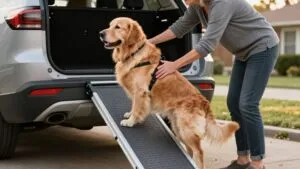
An SUV with a 24-inch cargo-floor height typically needs a 60-inch ramp for a manageable slope of about 22–23°, while a 72-inch ramp lowers it to roughly 18° for senior, arthritic, or short-legged dogs. Measure from ground to point where your dog steps onto cargo floor, not bumper. Set ramp squarely, upper end supported and lower end on level ground.
At 22–23°, healthy adults maintain a natural stride; at 18°, less joint flexion and hind-limb force can ease entry for dogs with painful hips, knees, or spine. Guide a slow, straight ascent with a harness instead of pulling a collar.
Use a wide, high-traction surface and raised edges to limit slips or side-stepping. Don’t let your dog jump from the hatch; guide descent too.
Check Ramp Weight Capacity
Always choose a ramp rated well above your dog’s body weight, including the shifting force created as they walk, pause, or turn on the slope. Dynamic loading can concentrate stress at the paws, carpi, elbows, shoulders, hips, and spine, especially when a dog stops abruptly. Check the label before every trip; damage, wet surfaces, and age can reduce real-world performance.
- Weigh your dog, then include any harness or mobility support.
- Use the manufacturer’s stated maximum, not an estimate.
- For large dogs, favor rigid ramps with a substantial safety margin.
- Stop using any ramp that visibly bows, shifts, or feels unstable under your dog’s gait.
Don’t treat capacity as a target. Keep reserve.
Inspect Hinge Pins Monthly
Monthly, inspect every hinge pin, locking joint, and rivet on a folding or telescoping dog ramp for looseness, corrosion, cracks, or binding. A compromised joint can shift under your dog’s weight, abruptly changing the ramp angle and stressing paws, wrists, elbows, shoulders, hips, and spine. Before each trip, confirm the ramp opens, locks, and bears weight.
- Wipe joints clean so you can spot rust or hair buildup.
- Move each section slowly; it shouldn’t grind, wobble, or catch.
- Tighten only hardware the manufacturer identifies as adjustable.
- Stop using the ramp if a pin migrates, a lock fails, or metal cracks.
Replace components with manufacturer-approved parts. Don’t lubricate traction surfaces, and don’t improvise repairs with tape or wire. A stable ramp helps your dog maintain controlled steps.
Conclusion
Dog Ramp Length Chart: Ramp Length by Vehicle Height
Choose your dog ramp by measuring tailgate height, then use the longest practical ramp to reduce joint-loading angles. For a 30-inch tailgate, favor a gradual slope, a minimum 12-inch walking surface, and high-traction material, especially when wet. If your dog has arthritis, lengthen the ramp further to limit hip, knee, and spinal strain. Confirm weight capacity, stabilize the hinge, and inspect pins monthly. This protects paws, balance, and confidence on every loading trip you make.