How Steep Can a Dog Ramp Be? Safe Incline Angles by Dog Size
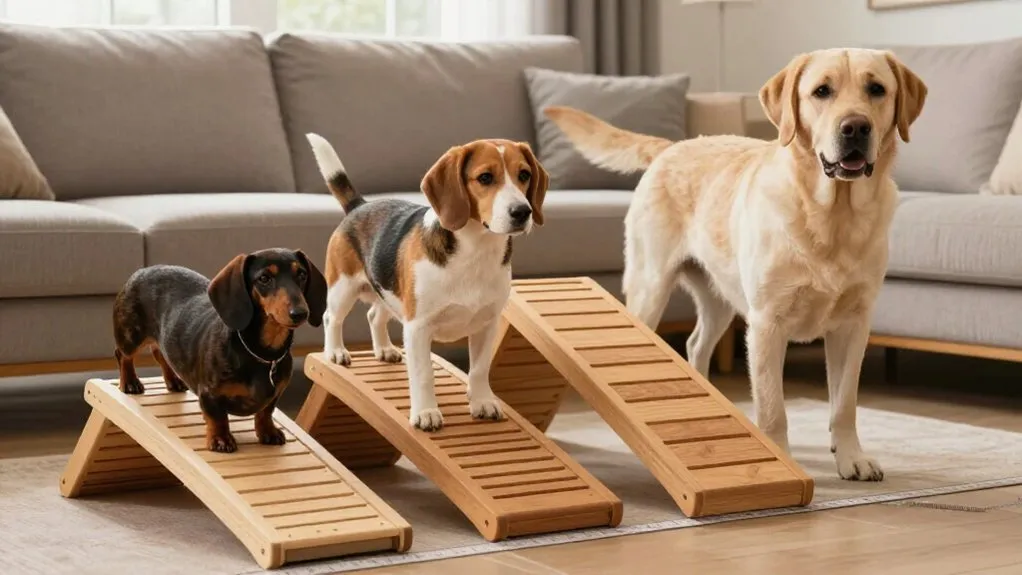
Keep your dog’s ramp as shallow as practical: aim for 18 to 20° for small or short-legged dogs, 20 to 22° for medium dogs, and no steeper than 25° for most large dogs. For seniors, arthritis, weakness, or recovery, stay near 18 to 22° when space allows and follow your veterinarian’s guidance.
Measure rise and horizontal run, not ramp length, and test traction and stability before use. You’ll also want to evaluate SUV setup, surface grip, and weight capacity details.
Measure Rise and Run First
Before choosing a ramp, measure the vertical rise from the ground to the landing surface, such as a sofa seat, bed, or vehicle cargo floor. Use a tape measure at the setup location, with the vehicle parked on level ground and the landing surface at its normal height. Then measure the available horizontal run: the clear floor or driveway distance where the ramp can rest without blocking passage or becoming unstable.
Record both dimensions before comparing products. A ramp’s usable length is measured along its walking surface, not straight out from the landing. Confirm that its top end seats securely, its bottom end cannot slide, and its footprint fits the space. If space restricts a longer ramp, don’t compensate by accepting an unsafe setup; consider another location or assistance instead.
Dog-Size Ramp Angle Chart
With the rise and available run recorded, use the chart below to match ramp angle to your dog’s size and mobility needs.
| Dog size | Target angle | Clinical adjustment |
|---|---|---|
| Small or short-legged | 18 to 20° | Choose near 18° for Dachshunds or hesitant dogs. |
| Medium | 20 to 22° | Start lower if joint discomfort affects gait. |
| Large | 22 to 25° maximum | Keep at or below 22° for seniors or arthritis. |
These ranges reflect rehabilitation consensus rather than a universal regulatory limit. You should select the shallowest setup your space permits, because decreasing the incline reduces per-step joint loading and improves confidence at the landing. For a dog recovering from surgery, showing pain, weakness, or neurologic deficits, don’t rely on this chart alone; ask your veterinarian or rehabilitation clinician to set an individualized limit.
Degrees Versus Slope Percentage
Degrees and slope percentage describe the same incline in different units, but they aren’t interchangeable numbers: a 20° ramp equals about a 36% grade, not 20%.
To convert a ramp, divide its vertical rise by its horizontal run, then multiply by 100. That result is grade percentage; the angle is arctangent of rise divided by run. Therefore, 25° is roughly 47% grade and 30° is roughly 58%.
When a manufacturer lists grade, convert it before comparing it with your dog’s degree-based target. For example, a 20% grade is only about 11°, shallower than 20°. Use the horizontal run, not the ramp’s sloping length, for percentage calculations. For an older, arthritic, or recovering dog, choose lowest practical angle and have your veterinarian set appropriate limits.
Traction Requirements by Surface Type
You need reliable paw grip because slip risk rises as ramp angle increases. Carpet can provide cushioning, rubber offers high traction, textured plastic needs secure tread, and wood requires a firmly attached nonslip covering. For outdoor use, choose weather-resistant surfaces that maintain grip when wet and inspect them regularly for wear.
Carpeted Ramp Grip
A carpeted dog ramp needs a firmly bonded, low-pile surface that provides reliable paw purchase without bunching, shedding, or becoming slick under dust and moisture. Choose dense, low-loop carpeting with nonslip backing, secured over the full deck and mechanically fastened at edges. Loose mats, high pile, and frayed seams can catch nails, shift under load, or reduce contact during descent.
Test grip routinely; vacuum and remove hair, grit, and dampness promptly. Inspect adhesive, staples, and edge binding weekly. Replace carpet if fibers flatten, detach, retain moisture, or create uneven footing. For senior, arthritic, neurologically impaired, or postoperative dogs, carpet traction doesn’t compensate for excessive incline: maintain a shallow angle and supervise initial use. Confirm the ramp remains rigid and stable at both landing points.
Rubber Surface Traction
Rubber ramp surfaces offer durable, high-traction footing when they remain dry, securely bonded, and textured enough for paws to grip during both ascent and descent. You should select a rubber covering with a raised tread pattern and firm, resilient backing rather than a smooth mat. Inspect it before each use for moisture, mud, hair, worn areas, lifted edges, or adhesive failure; each can reduce friction or create a trip point.
Clean the surface with pet-safe products and dry it completely after washing or rain exposure. At steeper inclines, slipping forces the dog to brace harder, increasing limb loading and fall risk. For seniors, arthritic dogs, or postoperative patients, use rubber only if it stays stable under load and supports paw placement. Replace compromised surfaces.
Textured Plastic Safety
Textured plastic can provide safe footing only when its molded tread gives paws reliable grip under expected conditions. Choose a ramp with closely spaced, raised patterns that support toe purchase without creating sharp pressure points. Inspect the entire walking surface for worn areas, smooth patches, cracks, or embedded grit; any can reduce traction or injure pads.
Test it dry and after exposure to rain, dew, mud, or cleaning products, because plastic often becomes more slippery when wet. If your dog has arthritis, neurologic weakness, long nails, or paw-pad disease, use the shallowest practical angle and require more aggressive, paw-safe tread. Avoid bare glossy plastic and abrasive textures that snag nails or abrade skin. Clean grooves routinely; dirt and oils can mask their grip.
Wooden Ramp Stability
Although wood provides a rigid, stable ramp base, its surface must deliver dependable paw traction in both dry and wet conditions. Bare, smooth, or gloss-sealed wood can let nails slide, particularly during descent, when forelimbs absorb braking forces. Cover the walking surface with securely bonded low-pile carpet, rubber, or a purpose-made non-slip tread that supports full paw contact. Avoid loose rugs, thick pile, and exposed fasteners; they can catch claws or create uneven footing.
Add closely spaced crosswise cleats only if their edges are rounded and low enough to avoid toe interference. Test traction while holding the ramp at its intended angle: your dog shouldn’t slip, wobble, or alter stride. Inspect the covering routinely for lifting, wear, or contamination that reduces grip underfoot.
Outdoor Weather Resistance
Rain, frost, and heat can quickly change a ramp’s grip, so choose an outdoor surface that maintains traction when wet and doesn’t become unsafe for paws in sun. Rubberized mats with molded texture usually provide the most reliable wet-weather grip; inspect them for cracking, lifted edges, and worn tread. Carpet and fabric covers can hold water, grow mildew, and lose friction unless they’re designed for exterior drainage.
Bare wood becomes slick in rain and needs a sealed, slip-resistant coating plus crosswise cleats. Avoid smooth plastic or PVC: it can become slippery when wet and hot in sunlight. Test the ramp after rain and on cold mornings; remove ice, mud, algae, and leaf debris. If traction changes, block access until you clean and fully dry it.
Adjust Angle for Arthritis
For a dog with arthritis, set the ramp at the shallowest practical incline, ideally 25° or less, to reduce joint torque during both ascent and descent. If space allows, target about 18 to 22°; a longer ramp lowers the effort required at each step and can improve confidence. Calculate length from the vertical rise: approximately 2.4 times the rise reaches 25°, while 2.9 times reaches 20°.
Secure both ends so the surface cannot shift under load, and use a continuous, high-traction surface to limit slips, which can abruptly load painful joints. Provide enough width for natural foot placement and raised edges if needed for orientation. Watch your dog closely: slowing, toe-dragging, reluctance, or a stiff recovery afterward means you should reduce the angle or stop use and consult your veterinarian. Follow postoperative restrictions and individualized rehabilitation guidance always.
Brachycephalic Dogs Need Flatter Ramps
Brachycephalic dogs, such as Pugs, French Bulldogs, and Bulldogs, often benefit from flatter ramps because their short airways can limit breathing efficiency during exertion. You should generally choose the lowest practical incline, rather than assuming that body size alone determines tolerance. A shallow slope reduces the work of climbing and may help limit respiratory effort, particularly in dogs with obesity, heat sensitivity, stenotic nares, or known brachycephalic obstructive airway syndrome.
Start near 18 to 20° when space permits, and make the ramp longer if your dog pants heavily, slows, or hesitates. Provide secure footing, stable support, and supervised use. Stop immediately for noisy breathing, cyanosis, weakness, distress, or collapse; consult your veterinarian before ramp use if your dog has respiratory disease, recurrent breathing concerns, or recent airway treatment.
SUV Cargo Ramp Setup
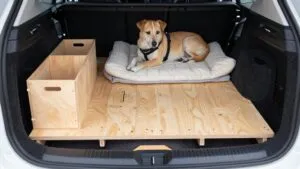
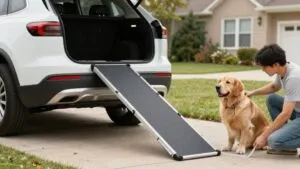
An SUV cargo ramp should create a stable, low-angle path from the ground to the cargo floor, not merely reach the bumper. Measure the vertical rise from level pavement to the cargo threshold, then select length from that measurement. For a 24-inch cargo height, a 60-inch ramp produces about a 22-degree incline.
Target 18 to 20 degrees for small dogs, 20 to 22 degrees for medium dogs, and generally no more than 25 degrees for large, senior, arthritic, or dysplastic dogs. You’ll need roughly 2.9 times the rise for 20 degrees and 2.4 times the rise for 25 degrees. Confirm that your parking area provides the required straight approach space. Choose a ramp wide enough for secure foot placement, with continuous high-traction covering and raised edges when needed.
Fixing Ramp Wobble
A correctly sized SUV ramp still becomes unsafe if it wobbles, shifts, or flexes under your dog’s weight. Movement can trigger a slip, abrupt joint loading, or lasting ramp avoidance. Before each use, stabilize both contact points and test the ramp with controlled hand pressure.
- Park on level, firm ground; engage the parking brake before positioning the ramp.
- Seat the upper lip fully against the cargo threshold, not on trim or a bumper edge.
- Extend or lock the ramp exactly as instructed, and confirm every hinge is fully engaged.
- Use non-slip feet or an approved anchor point to prevent the lower end from skating.
- Stop use if you hear creaking, see twisting, or detect side-to-side play; reposition it. Recheck alignment after moving your vehicle.
Check Ramp Weight Rating
Even a stable ramp can fail if its rated capacity doesn’t safely exceed your dog’s body weight. Dynamic loading rises when your dog walks, pauses, or enters from the side, so don’t treat the rating as a minimum target. Choose a manufacturer-stated capacity with a meaningful safety margin, especially for large, senior, or unsteady dogs.
- Confirm the rating applies to the fully extended ramp.
- Include harnesses, mobility aids, and carried gear in total load.
- Avoid ramps with missing, vague, or unverifiable capacity claims.
- Inspect hinges, locks, feet, and platform attachment before every use.
- Replace any ramp that flexes, cracks, shifts, or has damaged traction.
A capacity rating doesn’t guarantee safety: verify secure contact points and a non-slip surface. For post-operative recovery, ask your veterinarian.
Conclusion
To protect your dog’s joints and confidence, measure the rise and run, then choose the shallowest practical angle. You’ll generally improve safety with more ramp length, firm traction, and a stable, weight-rated base. Flatten the setup further for small dogs, seniors, dogs with arthritis, and brachycephalic breeds. Test the ramp while supporting your dog, correct any wobble, and never force use. If your dog shows pain, slipping, or reluctance, ask your veterinarian for guidance promptly.