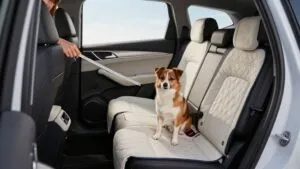
Dog Seat Cover Size Guide: Measurements for Sedans, SUVs and Trucks
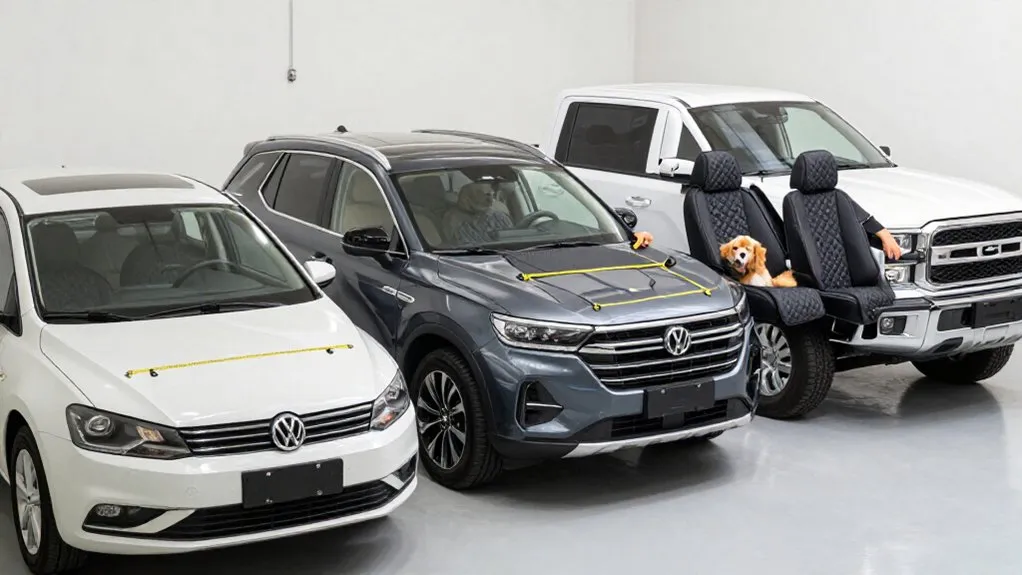
Measure your rear bench door-to-door width, cushion depth, seatback width, and headrest-post spacing before choosing a dog cover. Sedans usually need 54 to 60-inch covers and 18 to 22-inch depth; midsize SUVs fit 55 to 60 inches, while full-size SUVs and crew-cab trucks often require 60 to 66 inches and 22 to 24-inch depth. Allow two to four inches for adjustment.
Keep straps, flaps, and padding clear of seatbelts, LATCH points, vents, and side-airbag deployment zones. Next, you’ll see how to confirm cargo and hammock fit.
Measure Door-to-Door Span
Start by measuring the rear seating area at its widest usable point, from one door-side edge to the other. Open both rear doors and place a flexible tape level across the seat cushion, not across plastic trim or door pockets. Record the clear span where the cover will rest, then repeat at the seatback if side bolsters narrow it.
Measure in inches and note whether the vehicle has a 60/40 split, fold-down armrest, or raised center section. A cover needs enough width to reach the edges without pulling tight; allow two to four extra inches for adjustment. Keep belt buckles, LATCH anchors, airbags, and door latches unobstructed. In trucks and SUVs, check that straps won’t cross rear vent outlets or interfere with folding seatbacks during normal travel.
Vehicle-Specific Cover Size Chart
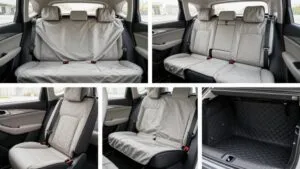
A vehicle-specific size chart helps you match the cover to your actual seating area rather than relying on a generic “fits most” claim. Measure the widest rear cushion, depth, and seatback height before ordering. Choose enough overlap to protect edges without covering buckles, LATCH points, sensors, or airbags.
| Vehicle | Measure and select |
|---|---|
| Sedan | 54 to 60-in bench; 54 to 60-in bench or hammock |
| Midsize SUV | 55 to 60-in bench; cargo 46 to 56 × 60 to 84 in |
| Full-size SUV/crew truck | 60 to 66-in bench; XL liner or extender |
For cargo setups, measure seatback-to-bumper length and confirm bumper-flap coverage. If you use a hard-bottom extender, verify its rigid panel fits the footwell and doesn’t restrict rear-seat access. Front bucket inserts suit 20 to 26-inch-wide seats; check seatbelt openings before driving. This keeps your dog securely positioned on trips.
Hammock Anchor Strap Definitions
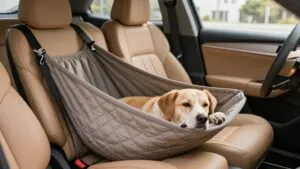
Hammock anchor straps secure the cover between your rear and front headrests, creating a raised barrier that helps keep your dog out of the footwell. Each strap runs from a reinforced upper cover corner to a headrest post and uses an adjustable buckle to set tension.
Measure the front-to-rear headrest distance with both seats in their normal driving positions. Choose straps that adjust beyond that measurement without forcing the buckle against the headrest. In sedans, verify fixed or integrated headrests accept the strap; some don’t.
In SUVs and crew cab trucks, check that rear headrests remain upright and that straps clear rear HVAC controls. Tighten both sides evenly until the cover stays level under light pressure. Keep seatbelt buckles and child-seat anchors fully accessible.
Rear Bench Depth: 18–24 Inches
Measure your rear bench from the backrest seam to the front edge: sedans typically run 18 to 22 inches, while SUVs commonly reach 20 to 24 inches. If you drive a crew-cab truck or full-size SUV, verify deeper cushions separately so the cover doesn’t pull tight or expose the seat edge. Leave enough depth for seat anchors and secure strap routing without blocking seatbelt access or LATCH anchors.
Measuring Rear Bench Depth
How deep is your rear bench from the backrest seam to the front seat edge? Use a flexible tape measure and keep it flat against the cushion; don’t follow a curved bolster or tuck it into the seat crease. Record the straight-line distance in inches at the center and again near each seating position if the cushion shape changes.
A depth between 18 to 24 inches generally suits common rear-seat cover panels, but compare your result with the manufacturer’s listed seat-area length. Choose enough material to reach the front edge without bunching under paws or leaving exposed upholstery. Secure anchors after measuring; a loose cover can slide and affect your dog’s footing. Confirm that belt slots, LATCH points, seat folds, and side airbags remain unobstructed entirely.
Standard Sedan Bench Depth
For most standard sedans, the rear bench cushion measures about 18 to 22 inches deep, though a cover sized for up to 24 inches gives you useful fit tolerance.
Measure from the backrest seam to the front edge of the cushion, following its contour rather than measuring across a sagging cover. If your result is 18 to 20 inches, choose a cover with adjustable front anchors or elastic edging so excess material doesn’t bunch under your dog. At 21 to 24, confirm the cover’s stated usable depth, not only its overall length.
Secure headrest straps evenly and press seat anchors into the seat crease. Keep seatbelt buckles and child-seat anchors uncovered; a poorly positioned cover can obstruct restraint access or slide toward the footwell during braking. Check fit before driving.
SUV Seating Depth Range
SUV rear bench cushions typically run 18 to 24 inches deep, with midsize models often measuring 20 to 24 inches from the backrest seam to the front seat edge. Measure your SUV across the cushion, avoiding rounded bolsters that can distort the result. A cover should reach the seat edge without hanging so far forward that it bunches beneath your dog’s paws. For an 18 to 20-inch cushion, confirm adjustable anchors can tension the material; for 21 to 24 inches, choose sufficient panel length to cover the sitting surface.
Check depth with the rear seats reclined or slid if your model offers those settings. Secure headrest straps, seat anchors, and nonslip backing driving. Keep seatbelt openings and LATCH points accessible and make sure the cover doesn’t obstruct rear-seat sensors or side airbags.
Truck Bench Fit Considerations
Truck rear benches vary sharply by cab style, so measure the cushion depth from the backrest seam to the front edge before choosing a cover. Extended-cab benches can sit near 18 inches deep, while many crew-cab rear cushions reach 22 to 24 inches. Match your measurement to the cover’s stated usable depth, not only its overall length. A cover that’s too shallow leaves the front bolster exposed; one that’s too deep can bunch under paws and reduce traction.
Measure bench width at its widest point, especially around sculpted door-side bolsters. Trucks commonly span 50 to 64 inches, and full-size crew cabs may need an XL option. Choose non-slip backing and confirm that belt openings align with your truck’s seating positions. Avoid airbag zones.
Allowing Room For Anchors
Once you’ve confirmed bench width and cushion depth, reserve a few inches of usable depth for the cover’s seat anchors and front-edge retention. On an 18-inch sedan cushion, choose a cover whose anchors tuck firmly into the backrest-to-cushion crease without pulling the front edge upward. You need roughly 2–3 inches of allowance for anchor placement, elastic, or under-seat straps. For 20–24-inch SUV benches, confirm that extra depth doesn’t leave loose fabric where paws can slide.
Press anchors deep into the seat bight, then pull the cover forward evenly and tighten headrest straps. Check that buckles, seatbelt slots, LATCH points, and rear-seat release handles remain accessible. Don’t route straps across seat tracks, wiring, vents, or airbag areas. After installation, tug the cover; it shouldn’t shift during braking or turns.
Use Two-Inch Fit Tolerance
Use a two-inch fit tolerance when comparing your back-seat width to a dog seat cover’s listed dimensions. Measure across the widest usable section of the rear bench, from one seat edge to the other, rather than guessing from door panel to door panel. If your sedan’s bench measures 55 inches, a 57-inch cover generally gives enough material for secure edge coverage without loose bunching.
For a 60-inch midsize-SUV bench, choose about 62 inches when the design uses fixed side panels. In a crew-cab truck, confirm both width and folded-seat geometry before sizing up. This small allowance accounts for curved bolsters, stitched seams, and manufacturing variation. Don’t add extra width blindly: excess fabric can slide, wrinkle, or cover belt access points. After installation, tug the cover firmly.
Avoid Blocking Side Airbags
A secure fit also must preserve every safety system around the seat. Before buying, check your owner’s manual to identify whether side-impact airbags deploy from the seatback, outer bolster, door, or roof rail. Measure the clear zone from each marked seam or panel to the cover edge, and don’t let fabric, straps, clips, or thick padding cross it.
In sedans, a 52 to 57-inch bench may place airbag-related trim close to the doors; choose a cover with unsecured side flaps or none. On 55 to 60-inch midsize SUV benches and 60 to 66-inch full-size SUV or truck benches, confirm extended wings don’t cover labeled deployment areas. Route headrest straps only through approved positions. Keep belt openings, LATCH anchors, and sensors accessible, and verify the manufacturer lists airbag-compatible installation for the vehicle.
Golden Retriever in Crew Cab
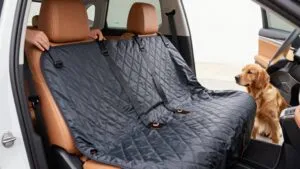
Because crew-cab rear benches commonly measure 60 to 66 inches wide and 22 to 26 inches deep, a Golden Retriever typically needs an XL hammock or hard-bottom cover rather than a 54-inch universal model. Measure your bench at its widest door-to-door point and compare it with the cover’s stated width; allow two to four inches of adjustment without leaving exposed edges. Choose a cover at least 60 inches wide and long enough to reach from rear seatback to front seatbacks when used in hammock mode.
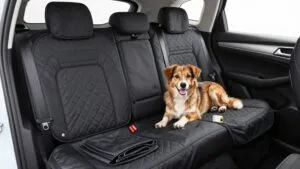
For safety, use non-slip backing, seat anchors, and side flaps so your dog doesn’t slide into the footwell during braking. Keep harness-compatible belt openings accessible and confirm the cover doesn’t obstruct rear HVAC vents or LATCH anchors. Select sealed-seam waterproof 600D fabric for muddy paws.
Check Headrest Post Spacing
Measure the distance between each pair of rear headrest posts before choosing a hammock-style cover, since its straps must sit securely without twisting or slipping. Use a tape measure from post center to post center, then compare that number with the cover maker’s stated strap range. Sedans often have tighter, fixed positions; SUVs and crew-cab trucks may use wider, adjustable headrests.
Don’t force straps around posts or route them near moving headrest hardware. Measure at the post bases for repeatable results.
- Record the spacing for every usable rear headrest position.
- Confirm straps clear seatbelt guides and child-seat tether access.
- Check that the buckle or adjuster rests flat.
- Pull each strap firmly; it shouldn’t shift sideways.
- Recheck fit after raising or lowering adjustable headrests.
Record Wheel-Well Intrusion Width
Next, record how far each rear wheel well projects into the cargo or folded-seat area, especially in SUVs, wagons, and trucks. Measure from the interior sidewall to the wheel-well edge at its widest point on both sides. Record each number in inches; asymmetry can leave a liner bunched or exposed. Verify that side flaps lie flat without covering cargo anchors, seatbelt hardware, or access panels. For hard-bottom extenders, confirm panels can sit level and don’t press against plastic trim during braking or cornering.
- Use a rigid tape measure for curved trim.
- Measure left and right wells separately.
- Note the narrowest clear span between intrusions.
- Compare that span with the cover’s usable width.
- Choose a liner that clears trim yet doesn’t slide during normal driving.
Conclusion
Measure your rear seating area before you buy, then match your sedan, SUV, or truck to the chart. You’ll get the safest fit when you confirm door-to-door span, bench depth, headrest-post spacing, and wheel-well intrusion. Allow a two-inch tolerance, but don’t let straps cover side airbags or obstruct seat belts.
In crew cabs, check that your Golden Retriever can sit comfortably without stressing anchors. Recheck every connection before each drive for secure travel with confidence.