Car Temperature Chart for Dogs: Outside vs Inside Temps by Minute
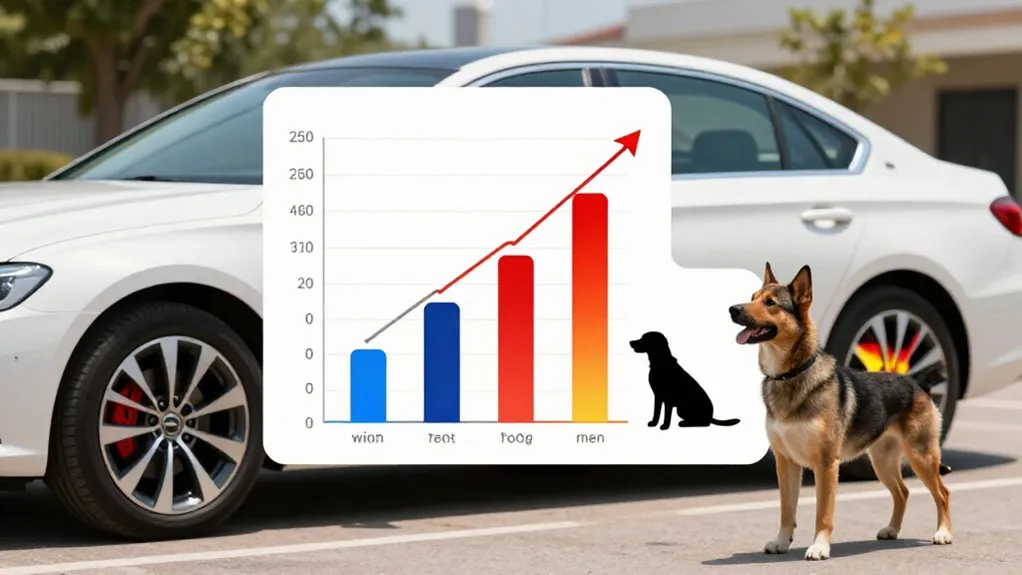
You can’t use a parked-car temperature chart as a safe-time allowance: at 70°F (21°C) outdoors, your cabin may reach about 89°F in 10 minutes; at 75°F (24°C), it may reach 94 to 100°F. Cracked windows, shade, tint, and dashboard readings don’t reliably prevent dangerous heating.
Humidity also limits panting. Never leave your dog unattended; short-muzzled, older, young, overweight, and ill dogs face greater risk. The details below explain why minutes matter so quickly in real conditions outside.
Shade Versus Sun Exposure
Shade slows a car’s heat gain, but it doesn’t make a parked vehicle safe for a dog. Direct sunlight remains the heating source: glass admits solar energy, and interior surfaces absorb and reradiate it as heat. A shaded space may lower cabin temperature by only about 5 to 10°F (3 to 6°C) under favorable conditions, not enough to establish safety.
You can’t rely on shade, a cracked window, tint, or a light-colored vehicle as protective measures. Pavement can radiate heat, while humidity limits your dog’s cooling through panting. Short-muzzled dogs, puppies, older dogs, and those with obesity or heart or airway disease face greater risk. Keep your dog with you in climate-controlled spaces or leave them home. If you see distress, remove the dog and seek veterinary care.
Minute-by-Minute Cabin Temperature Rise
A parked car can gain about 19°F (11°C) in its first 10 minutes, roughly 29°F (16°C) by 20 minutes, and more than 40°F (22°C) within an hour. These are approximate rises above the starting outdoor temperature, not a safe-time allowance. Direct sun can accelerate heating, but a cracked window doesn’t reliably stop it.
| Elapsed time | Cabin change | Dog risk |
|---|---|---|
| 0 minutes | Baseline | Conditions can deteriorate |
| 10 minutes | About +19°F | Heat stress may begin as cabin temperature climbs |
| 20 minutes | +29°F | Panting may no longer control body heat effectively |
| 60 minutes | More than +40°F | Hyperthermia can progress to organ injury or death |
Logging has recorded daytime internal peaks above 35°C in temperate climates. Don’t treat any errand as safe; leave your dog home, not unattended.
Fahrenheit-to-Celsius Temperature Conversions
Use this conversion guide to interpret car-temperature warnings quickly: 70°F is 21°C, 85°F is 29°C, 100°F is 38°C, 104°F is 40°C, and 106°F is 41°C.
When you compare weather reports, vehicle displays, or veterinary guidance, use these rounded values to judge risk without delay. At 70°F (21°C) outdoors, a parked cabin can become hazardous within minutes.
At 85°F (29°C) inside, heat stress may begin, marked by persistent panting, agitation, or drooling. Read 100°F (38°C) and 104°F (40°C) as severe cabin heat, not tolerable conditions.
A body temperature near 106°F (41°C) signals a heatstroke emergency; organ injury can develop rapidly. Celsius figures don’t make the danger lower, they describe the same thermal exposure. If you see rising temperatures, remove your dog from the vehicle and seek veterinary advice if illness signs occur.
Breed-Specific Heat Tolerance
Your dog’s breed and body type can change how quickly heat illness develops in a parked car. You should treat brachycephalic dogs, double-coated breeds, small dogs, seniors, puppies, and dogs with obesity or heart or airway disease as higher-risk, even if they’re acclimated to warm weather. Breeds such as Pugs, Bulldogs, French Bulldogs, and Boxers have reduced respiratory cooling, so don’t rely on panting, cracked windows, or shade to keep them safe.
Brachycephalic Breeds Overheat Faster
Because brachycephalic dogs—such as pugs, bulldogs, and Boston terriers—have shortened airways that limit efficient panting, they can overheat faster than long-muzzled breeds in a parked car. Their narrowed nostrils, elongated soft palates, and relatively small tracheas increase airflow resistance, so they can’t dissipate heat effectively through panting. As cabin temperature climbs, especially with humidity, respiratory effort can worsen airway obstruction and raise body temperature rapidly.
Don’t rely on a cracked window, shade, water, or a brief errand to protect your dog; none provides reliable cooling in a parked vehicle. Avoid leaving a flat-faced dog unattended whenever conditions are warm, and treat temperatures around 85°F (29°C) inside the car as potentially hazardous. Watch for panting, drooling, weakness, vomiting, altered gums, or collapse; seek veterinary care.
Double-Coated Dogs and Heat
Although double-coated breeds such as Huskies, Malamutes, and German Shepherds have insulating fur, that coat doesn’t protect them from a rapidly heating parked car. The outer guard hairs and dense undercoat can buffer environmental conditions, but they don’t stop heat absorbed through vehicle glass or lower the cabin temperature. As the interior climbs, your dog must lose heat mainly by panting.
At high cabin temperatures, especially with humidity, panting becomes progressively less effective and body temperature can rise quickly. A cracked window doesn’t provide reliable cooling, and shade only modestly reduces heating. Don’t assume a northern or heavy-coated breed has extra time in a parked vehicle. Keep your dog with you or leave them in a climate-controlled setting whenever conditions could warm the car.
Size, Age, and Health
Coat type isn’t the only factor that changes a dog’s heat tolerance in a parked car: size, age, and underlying health can sharply narrow the margin for safety. If you have a brachycephalic dog, such as a Pug, Bulldog, or Boston Terrier, its shortened airways limit respiratory heat loss; it can overheat faster than a long-muzzled dog. Puppies and senior dogs regulate body temperature less reliably, while obesity adds insulation and increases the work of breathing.
Heart disease, airway disorders, and other respiratory conditions further reduce your dog’s ability to compensate as cabin temperature climbs. Small dogs may cool rapidly in cold vehicles, especially if they are thin-coated. A vulnerable dog can face an emergency within minutes as the parked cabin heats around it.
Acclimation Changes Heat Risk
Acclimation to warm weather may improve a dog’s tolerance for outdoor activity, but it doesn’t make a parked car safe. Over days to weeks, heat exposure supports cardiovascular adjustments, panting responses, and efficient heat dissipation during supervised exercise.
It cannot overcome the greenhouse heating of an enclosed vehicle, where air temperature may rise about 20°F in 10 minutes. Your dog’s heat tolerance varies with coat insulation, size, airway anatomy, fitness, and medical status. Dogs with less efficient respiratory cooling have a narrower margin before panting fails, especially when humidity is high.
Don’t use a dog’s apparent comfort on walks, previous warm-weather exposure, or breed reputation to calculate car time. Cabin heat can trigger hyperthermia quickly; take your dog with you or leave them home.
High-Risk Breed Examples
Short-muzzled (brachycephalic) breeds—such as pugs, bulldogs, Boston terriers, boxers, and Pekingese—face especially rapid heat risk in parked cars because narrowed airways limit the cooling power of panting. For these dogs, a car that reaches 85°F can trigger heat-stress signs sooner than in many long-muzzled dogs. Don’t assume a cracked window, shade, or water makes the exposure safe.
You should also treat dogs with obesity, heart disease, respiratory disease, or limited mobility as high risk, regardless of breed. Puppies and senior dogs have less physiologic reserve.
Thick-coated breeds, including huskies and malamutes, can overheat as cabin temperature climbs. Never leave any vulnerable dog unattended when outdoor temperatures approach 70°F; risk can become critical within minutes. Choose air-conditioned transport, bring your dog inside, or leave them home.
Adjusting Charts for Humidity
Humidity doesn’t greatly change how quickly a parked car heats up, but it makes the temperature on a car safety chart more dangerous for your dog because humid air limits the cooling effect of panting. Use the chart’s temperature and time estimates as a starting point, then treat high humidity as an added physiologic hazard. Dogs dissipate heat by evaporating moisture during panting; when air moisture is high, evaporation slows. Your dog may as a result overheat at the same cabin temperature sooner than the chart suggests.
Be especially conservative if your dog is short-muzzled, older, young, overweight, or has heart or airway disease. Don’t wait for a humidity-adjusted “safe” minute limit: at warm temperatures, no unattended car time is reliably safe. Choose safer options instead.
Cracked Windows Aren’t Safe
Cracking the windows a few inches doesn’t make a parked car safe for your dog. Small openings provide little ventilation and don’t stop solar radiation from heating the cabin. The greenhouse effect remains dominant: sunlight passes through glass, and interior surfaces release heat that becomes trapped.
On a 75°F day, a vehicle’s interior may reach roughly 94–100°F within 10 minutes, even with cracked windows. At about 85°F, your dog may develop heat stress, including heavy panting and anxiety. Panting cannot cool a dog in hot, humid air, and short-muzzled, senior, young, obese, or cardiopulmonary-compromised dogs can deteriorate faster.
Don’t treat a window gap as a protective measure. Keep your dog with you or in a climate-controlled environment whenever parking conditions could heat the cabin.
Grocery-Store Stop Example
A “quick” grocery-store stop can become dangerous before you reach the checkout: on a 75°F (24°C) day, a parked car may climb to about 94–100°F (34–38°C) within 10 minutes and roughly 109°F (43°C) by 30 minutes. That interval disappears in parking, selecting items, waiting in line, and returning to your vehicle. Your dog may develop heat stress before you finish: heavy panting, distress, thick drool, weakness, vomiting, or disorientation require immediate action.
Dogs dissipate heat mainly through panting, so hot enclosed air, particularly humid air, rapidly limits cooling. Puppies, senior dogs, flat-faced breeds, and dogs with obesity, heart disease, or airway disease face greater risk. Don’t plan a brief errand around a parked car. Leave your dog home; use pet-friendly pickup or air-conditioned transport.
Dashboard Thermometer Misreadings
Your dashboard thermometer reports the outdoor air temperature—not the rapidly changing heat inside the cabin—so it can create a false sense of safety. It measures conditions near the vehicle, while sunlight heats glass, seats, and trapped cabin air.
- A reading of 70°F doesn’t mean the cabin remains 70°F; it may reach about 89°F within 10 minutes.
- At 75°F outdoors, cabin temperatures can approach 94 to 100°F in 10 minutes.
- Cracked windows don’t provide reliable cooling because solar heat remains trapped.
- Shade may slow heating modestly, but it doesn’t make an unattended car safe.
Treat the display as a weather reference, not a pet-safety monitor. Interior temperature, sun exposure, humidity, and parking time determine risk. If you can’t control climate, take your dog or leave them home.
Emergency Signs: Excessive Panting
Excessive, rapid panting in a parked car can signal early heat stress, especially when it doesn’t ease after you move your dog into cooler air. Panting fails as temperatures and humidity rise, so don’t wait to see whether your dog “settles down.” Act immediately:
- Move your dog into air conditioning or shade.
- Apply lukewarm water to the coat and use airflow; avoid ice-cold water.
- Offer small amounts of water only if your dog is alert and able to swallow.
- Seek urgent veterinary care for weakness, vomiting, confusion, abnormal gum color, or collapse.
Short-muzzled dogs, seniors, puppies, and dogs with obesity, heart disease, or airway disease can deteriorate faster. Even if panting improves during cooling, a veterinarian should assess heat illness because injury may follow.
Conclusion
Your car can become dangerously hot within minutes, even in shade or with cracked windows. You shouldn’t rely on dashboard readings, breed, or safety; humidity and sun can accelerate heat stress. If you must stop, take your dog with you or arrange climate-controlled care. Watch for excessive panting, drooling, weakness, vomiting, collapse, or confusion. Treat suspected overheating as an emergency: move your dog to cool air, begin gentle cooling, and contact a veterinarian.
Car Interior Temperature Calculator for Dogs (Hot & Cold)
Estimate how hot a parked car gets after 0–60 minutes from the outside temperature, based on published data, plus cold-car facts for dogs.