Which Dog Crates Are Crash Tested? CPS-Certified Crates Listed
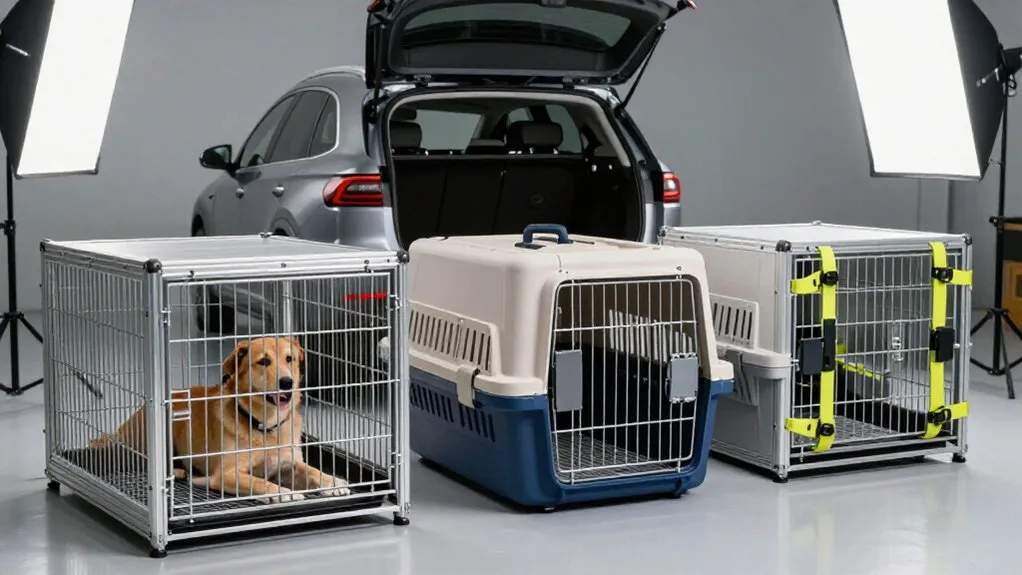
Choose only a Center for Pet Safety (CPS)-certified crate whose exact model, size, hardware, and tie-down setup match the certification record.
Reported CPS-tested options include Gunner G1 Intermediate (2015, dogs up to 75 pounds), related G1 Small/Medium versions, and certain Gunner Large/XL and Lucky Duck large kennels, but you must verify each listing, test date, weight limit, and anchors.
Don’t equate “crash-tested” marketing with certification. Next, confirm vehicle fit, strap routing, and latch checks.
CPS-Certified Crate Models
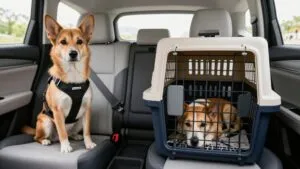
When crash protection is your priority, choose a crate with Center for Pet Safety (CPS) certification for the exact model and size you’ll use. CPS certification indicates that a specific crate configuration met the organization’s crash-test requirements, rather than merely carrying a manufacturer’s “crash-tested” claim.
You can look for certified options from brands such as Gunner and Lucky Duck, but verify the particular kennel before buying. A qualifying crate should pair a rigid, impact-resistant shell with a secure door, reliable latches, and dedicated anchoring provisions. These elements help limit crate movement and retain your dog during an impact. Install it exactly as directed, using compatible rated tie-downs and suitable vehicle anchors. Also inspect its door, hardware, shell, and straps regularly; damage can compromise protection.
CPS Test Year by Model
CPS test years matter because certification attaches to a specific crate model, size, and tested configuration—not an entire brand lineup. When you compare a crate, match its model and size to the dated CPS record and its tested setup.
| Model | CPS test year | What you should confirm |
|---|---|---|
| Gunner G1 Intermediate | 2015 | Weight and anchor setup |
| Gunner G1 Small/Medium | 2015 campaign cited | Current CPS record |
| Gunner G1 Large/XL | Verify by variant | Report date and scope |
Gunner identifies G1 Intermediate as passing the 2015 CPS crate study. Its pages connect Small and Medium G1 versions to that campaign. Before you buy, check CPS records for report number, test date, weight class, tether method, and anchor method. Don’t treat an unverified size or revised configuration as covered.
CPS Certification vs. Manufacturer Claims
A manufacturer’s “crash-tested” claim doesn’t equal CPS certification. A brand may test a crate internally, use an undisclosed protocol, or show footage from a single impact. That evidence can be useful, but it doesn’t prove that an independent organization verified the product against defined pass/fail criteria.
CPS certification gives you a clearer standard. Center for Pet Safety evaluates the specific crate configuration, its door and latches, structural integrity, anchors, and tie-down system in controlled crash testing. Inspect the official CPS certified-products list, then match the listed model, model year, and required hardware to what you plan to buy. Don’t assume a certified product line means every version qualifies. Ask the manufacturer for the certification record and installation instructions. Secure it as tested, every trip.
CPS-Certified Crate Dimensions
CPS certification applies to specific crate sizes, so you must confirm the model’s tested dimensions and maximum dog weight. Measure the usable interior space, match it to your dog’s standing, turning, and resting needs, and don’t assume a larger size carries the same certification. Before buying, verify that the crate fits your vehicle and can be secured with the tested anchor and tie-down system.
Certified Crate Size Options
Certified crash-tested crate sizing depends on the exact model, not just the brand name: Gunner’s G1 Intermediate, for example, carries CPS certification for dogs up to 75 pounds, while at least one Lucky Duck large kennel size is certified for dogs up to roughly 110 pounds. That distinction matters because CPS evaluates a specific configuration under controlled crash conditions; it doesn’t automatically approve every larger or smaller version.
Before you buy, confirm the model, size, maximum tested dog weight, and current certification on CPS’s official list and the manufacturer’s product page. Use only the tested tie-down hardware and installation method. A crate can protect your dog only when its certified size and restraint system match the product tested in a collision scenario as intended.
Measuring Interior Crate Space
Before choosing a CPS-certified crate size, measure the interior’s usable length, width, and height—not just the exterior footprint—and compare those figures with your dog’s standing height, body length, and ability to turn around comfortably. Measure from the inside face of the closed door to the rear wall, between the narrowest sidewalls, and from the floor to the lowest overhead point. Record dimensions after installing manufacturer-approved pads, dividers, or accessories, because each reduces available room.
Include contours, wheel wells, door frames, latch housings, and ventilation ribs when they intrude into usable space. Check interior measurements, but verify the crate yourself; nominal figures may describe exterior size. Don’t add liners or modifications that obstruct the door, reduce ventilation, interfere with latches, or change the tested configuration.
Matching Dogs To Dimensions
Match your dog to the exact crate size and maximum tested weight shown on its CPS certification, not merely to a brand’s general sizing chart. Choose a certified size that lets your dog stand naturally, turn around, and lie down without being cramped or sliding excessively. The label’s weight limit is a crash-test boundary, not a rough recommendation; don’t place a heavier dog in that model.
CPS certification applies to the specific model and size tested, not automatically to every size in a product line. For example, a Gunner G1 Intermediate is certified up to 75 pounds, while a larger dog requires a separately certified option. Verify your dog’s current weight and the certification’s stated limit before purchase. Recheck when puppies grow or condition changes.
Vehicle Fit Considerations
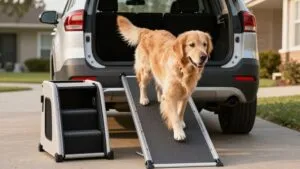
A crate can fit your dog correctly yet fail to fit your vehicle’s cargo area or anchor layout safely. Before buying, measure the cargo floor’s usable length, width, and height, accounting for wheel wells, hatch slope, seat position, and door clearance. Then confirm the certified crate’s exterior dimensions, not just its interior space. It must sit level without forcing the hatch, rear seats, or crate door against one another.
Locate your vehicle’s designated cargo anchors and verify that the manufacturer-approved tie-downs reach them at the specified angles. Don’t improvise with bungee cords, seat-belt routing, or weak cargo hooks. Certification depends on the tested crate and secure attachment system working together. Check access to ventilation openings and make sure no trim or loose cargo can interfere.
Weight Limits By Size
Each CPS certification applies to a specific crate size and maximum tested dog weight—not an entire product line. Match your dog’s current weight to the limit shown for that exact model and size, then confirm the certification on CPS’s current list or the manufacturer’s page. For example, the Gunner G1 Intermediate has certification for dogs up to 75 pounds. Some Lucky Duck large kennels have been reported as certified for dogs around 110 pounds, but you should verify the precise version before buying.
Don’t move up or down in size assuming the result carries over. A larger shell, different door, or altered anchor geometry can change crash performance. Keep your dog within the tested limit, use the specified tie-downs, and replace hardware before travel.
Match Crate to Vehicle
Before you buy a crash-tested crate, confirm that its certified size fits your vehicle’s cargo area and can be secured exactly as the manufacturer specifies. Measure usable floor length, width, and height, including wheel wells and hatch clearance. A crate that fits may block the liftgate or sit unevenly, weakening tie-down geometry. Check your owner’s manual and crate maker’s instructions for anchors, strap routing, and orientation.
Don’t improvise with hooks, bungees, or untested extensions. The crate must rest on a level surface without crushing ventilation openings or interfering with closing doors. Install the rated tie-down kit, tighten it as directed, then test for movement. If your vehicle lacks suitable anchors or the certified crate cannot fit and secure correctly, choose a certified size or transport method.
Front Airbag Placement Risks
Proper crate fit and secure tie-downs don’t make the front passenger seat safe for a dog: a deploying front airbag can strike a crate, carrier, or unrestrained animal with violent force. Airbags deploy in milliseconds and are engineered to protect a properly positioned adult human, not a canine occupant or pet restraint.
If your dog rides in front, the inflating bag can crush the carrier against the seat, propel it rearward, or directly injure your dog. A crate’s CPS certification doesn’t establish safety in this airbag exposure zone; certification applies only to the specific crate, size, restraint hardware, and test configuration. Keep your dog behind the front seats, using the manufacturer-approved anchors and placement instructions for both your crate and vehicle at all times.
Hatchback Travel Crate Example
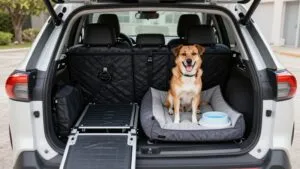
For a hatchback travel setup, place a CPS-certified crate in the rear cargo area only if its tested size fits the available floor space and you can secure it to approved vehicle anchor points with the specified tie-downs. Measure the cargo floor, hatch clearance, and crate footprint before you buy. Confirm that your dog’s weight falls within the exact CPS-certified size limit; certification doesn’t automatically extend to larger versions.
A Gunner G1 Intermediate, for example, earned CPS recognition for dogs up to 75 pounds, but you must verify current model-specific certification. Keep the crate level and clear of rear-seat release mechanisms, cargo covers, and loose items. Check that the hatch closes without contacting the crate. Inspect the door, latches, anchors, and hardware before every trip, because wear or damage can compromise crash-tested performance.
Incorrect Tie-Down Strap Routing
Incorrect tie-down strap routing can defeat a crate’s crash-tested design by allowing it to shift, rotate, or separate from its anchors in a collision. Certification reflects a crate, vehicle position, anchor system, strap type, and routing method. If you cross straps, use slack, attach to weak cargo hardware, or route webbing over sharp edges, impact forces can concentrate unpredictably. Follow the manufacturer’s tested configuration exactly.
- Use the anchor points; don’t substitute seat frames, plastic trim, or convenience hooks.
- Keep each strap flat and untwisted, remove slack according to the instructions.
- Route webbing between crate anchors and vehicle anchors without crossing or looping it.
- Inspect straps, buckles, and anchor hardware before every trip; replace cut, frayed, or damaged components.
Confirm Door Latch Engagement
Confirm that every door latch is fully seated and locked before you drive. CPS crash evaluations inspect latch retention after impact: an intact shell can’t protect your dog if the door opens. Clear the frame, close the door, and test each latch.
- Press or rotate each latch until it reaches its locked position.
- Pull the door outward; it shouldn’t shift, rattle, or release.
- Check that bedding, fur, tags, and leash hardware aren’t trapped in the closure.
- Inspect latches, pins, and mounting hardware for cracks, bends, corrosion, or looseness.
Don’t rely on a quick glance. Recheck after loading your dog and after adjusting tie-downs, since crate movement can affect alignment. Replace damaged components only with manufacturer-approved parts; an altered latch may not perform as tested.
Conclusion
Choose a dog crate based on independent CPS certification, not marketing language or size alone. Confirm the exact model, test year, dimensions, and vehicle fit before you travel. Position the crate away from front airbags, secure it with correctly routed tie-downs, and check every door latch.
Your safest setup matches your dog, crate, and vehicle. Recheck CPS records and manufacturer instructions regularly, because certification and installation details can change as standards evolve or products change.