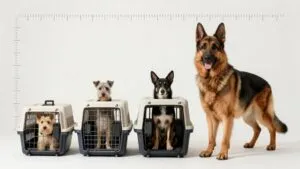
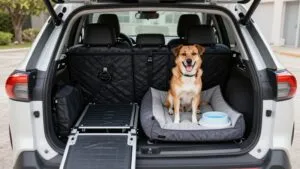
Dog Crate Dimensions for SUV Cargo Areas: Will It Fit Your Hatch?
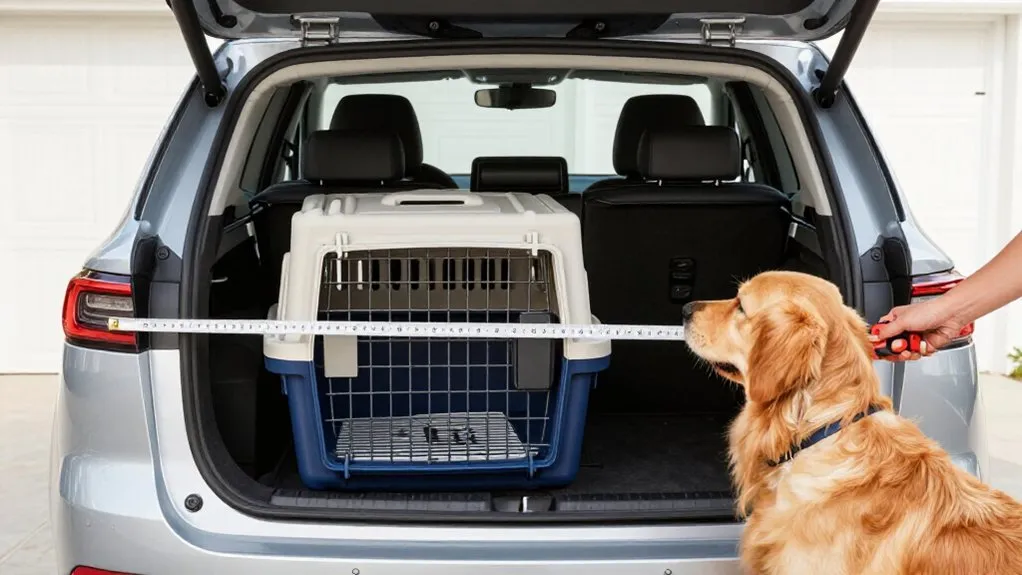
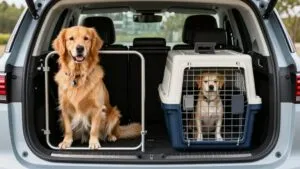
Your crate will fit only if its exterior dimensions clear the hatch opening, sill, wheel wells, and narrowest cargo-floor width. Measure the hatch at its tightest point, then check floor length, height, and door swing with seats positioned as used.
Leave 2–4 inches where practical, test a cardboard mock-up, and secure the crate to approved anchors. Keep it level and clear of curtain-airbag panels.
Next, you’ll find the measurements and checks that make travel safer overall.
Measure Hatch Opening Height
Measure the hatch opening height from the cargo floor or threshold to the lowest point of the open hatch frame, not just to the roof inside the SUV. This dimension tells you whether your dog’s crate can enter safely without catching on a spoiler, latch housing, or sloping edge. Park on level ground, open the hatch fully, and hold a rigid tape measure vertically at the tightest point. Record the smallest height in inches or centimeters.
Compare that number with the crate’s external height, including feet, handles, and top-mounted hardware. Leave several inches of clearance so you can load it smoothly without scraping your hands or startling your dog.
If you must tilt the crate while loading, check that it still clears the frame. Don’t trust cargo-volume figures; they won’t show this important entry restriction.
Crate Footprints by Hatch
Once a crate clears the hatch opening, its floor footprint determines whether it can sit securely in the cargo area. Compare your crate’s exterior length and width, not interior dimensions, with the narrowest floor space, then reserve 2–4 inches around it for airflow and handling.
| Hatch style | Best footprint approach |
|---|---|
| Square, boxy | Match rectangular crates to full-width floor. |
| Tapered, sloped | Check rear-corner width; use shorter footprint. |
| Vertical liftgate | Favor long crates when floor length allows. |
| Fastback | Choose compact crates; mock up angled sides. |
Don’t trust cargo volume alone. Wheel wells and angled side panels can steal usable width. Build a cardboard mock-up, position it, and confirm your dog can enter comfortably. Secure the final crate to rated cargo anchors so it can’t slide or tip abruptly.
Tailgate Sill Clearance Terms
Tailgate sill clearance describes the vertical and horizontal space at the cargo entrance that a crate must cross before it can rest on the floor. Measure the sill’s height from the ground and its depth from the edge to the cargo floor. A tall lip can make lifting a heavy crate awkward and increase the chance of a dropped load or frightened dog.
Check for raised trim, sloped plastic, latch hardware, and a step-up into the cabin. Confirm you can lift and slide the crate over the sill without scraping its base or tilting it. Use two people for bulky crates, keep your dog out of the loading area, and secure the crate after placement. A low threshold reduces strain and makes loading safer.
SUV Cargo Width Ranges
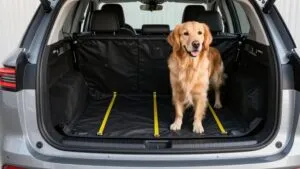
Measure your SUV’s cargo width at the narrow wheel-well point, then compare it with the crate’s outside width and the hatch opening. Folding the rear seats may add usable width or improve placement, but it won’t remove wheel-well limits. Leave clearance for airflow and secure the crate so your dog can ride safely without shifting.
Typical Cargo Width Measurements
Cargo width often determines whether a dog crate will sit safely flat in an SUV, especially around the wheel wells. Compact crossovers commonly offer roughly 38 to 45 inches across the cargo floor, while midsize SUVs may provide about 43 to 50 inches. Large SUVs can reach 48 to 60 inches or more, depending on trim and interior panels.
Measure your vehicle’s usable floor width in several places, then compare the smallest reading with the crate’s outside width. Don’t rely on cargo-volume ratings: they can’t show whether your dog’s crate has a stable footprint. Leave 2 to 4 inches of space around the crate for airflow, loading, and securing straps. Check the manufacturer’s crate dimensions, including protruding handles or door hardware, before you buy.
Wheel Well Width Limits
Wheel wells usually create the narrowest point in an SUV cargo area, so their inside-to-inside distance sets the real width limit for a dog crate. You’ll often find 36 to 42 inches in compact crossovers, 42 to 48 inches in midsize SUVs, and 48 inches or more in larger models. Measure at floor level where the crate rests, not above the wells where the cabin looks wider.
Compare that number with the crate’s width, including handles, latches, and protectors. Leave 2 to 4 inches of side clearance for airflow, cleaning, and a secure fit. If the crate barely squeezes between the wells, choose a narrower model. You need room to anchor it securely and keep your dog stable during turns and sudden stops.
Hatch Opening Clearance
Why does hatch opening clearance matter as much as the cargo floor width? Your crate may fit between the wheel wells, yet still strike the hatch frame, trim, or latch area during loading. Measure the opening’s narrowest width and lowest height, not just the cargo bay. Small SUVs often have tighter openings than their interior suggests; midsize and full-size models generally offer more room, but sloping rooflines can reduce usable clearance.
Compare those measurements with your crate’s outside width and height, then allow 2–4 inches for safe handling and airflow. Use a cardboard mock-up to test the route through the hatch, including any necessary angle.
Don’t force a crate past tight edges; damaged corners, pinched fingers, or a stressed dog can result. Confirm you can load and unload your dog calmly without tilting the crate dangerously.
Folded Seat Width Gains
Folding the second row can give you more usable crate width, especially where upright seatbacks, bolsters, or a center pass-through narrow the cargo area. With the seats flat, the floor behind them may offer a broader, more continuous surface, but SUVs vary widely. Compact models often have wheel-well pinch points, while midsize and full-size SUVs may provide wider floor sections ahead of the wells.
Measure width at several points: the rear threshold, wheel wells, side panels, and the folded-seat edge. Record the narrowest measurement your crate will occupy, not the widest span you see. Check for uneven seat folds, exposed latch hardware, and gaps that could let a crate tilt. Keep airflow space along sides, and use cargo anchors so your dog’s crate can’t slide during braking or turns.
Crate Size Compatibility
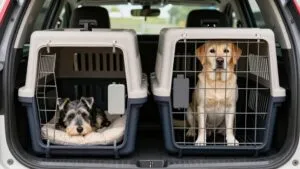
Once you’ve measured the narrowest usable floor width, match it to the crate’s external width, not its advertised dog-size label. Compact hatchbacks and smaller SUVs may offer only enough wheel-well clearance for small or medium crates, while many crossovers fit medium or large models. Mid-size and full-size SUVs often accept large, XL, or side-by-side crates, but high wheel wells can narrow the floor dramatically.
Give the crate 2 to 4 inches of breathing room around its sides for airflow, loading, and secure positioning. Don’t force a crate between trim panels or let it press against the hatch. Check width at the floor, opening, and any point where you’ll angle it inside. Then use cargo anchors to stop movement, keeping your dog stable and protected during sudden braking.
Account for Crate Door Swing
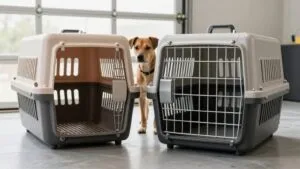
Before choosing a crate position, check that its door can open fully without striking the hatch, rear seats, wheel wells, or cargo trim. Measure the door’s swing arc and leave enough room for you to reach the latch safely.
Your dog shouldn’t need to squeeze past a partly opened panel or climb over the crate.
If the door faces rearward, confirm the open hatch provides full clearance. If it faces sideways, check that wheel wells and seatbacks don’t block it.
Use a cardboard mock-up or tape the door’s arc on the cargo floor. Choose a position that lets your dog enter and exit calmly while you keep hands clear of pinch points. Secure the crate after testing access, so it won’t shift and trap.
Avoid Airbag Deployment Zones
Keep your dog’s crate out of any airbag deployment zone, especially near front-seat side airbags, rear-seat side-curtain airbags, and seat-mounted airbags. Check your owner’s manual and the warning labels on pillars, headliner, seats, and trim before choosing a crate position.
An inflating airbag can strike the crate, force it toward your dog, or block its protective path. Put the crate only in a designated cargo-area location that stays clear of marked airbag panels and doesn’t press against side trim. Keep its top below the curtain-airbag path where possible. Secure it to approved cargo anchors so it can’t slide into a deployment area during braking or a crash.
If you’re unsure, ask your vehicle dealer or consult the manual before traveling with your dog aboard.
36-Inch Crate in RAV4
Measure the cargo floor from threshold to rear seatback, then measure hatch clearance at the tightest entry point. Leave 2–4 inches around the crate where possible so air can circulate and you can load it without forcing it. Confirm your dog can stand, turn, and lie flat comfortably. Test a cardboard mock-up before buying.
Once installed, keep the crate level, secure it to cargo anchors, and check that its door opens safely for loading.
Wheel-Well Width Misreads
Wheel wells often make an SUV cargo area look wider than the space a dog crate can actually use. You might measure the broad upper panels, then discover that the crate’s floor footprint hits both wheel arches. Measure at the exact floor height where the crate rests, from the narrowest wheel-well edge to edge. Compare that number with the crate’s external width, not its advertised dog-size category.
- Leave 2 to 4 inches of side clearance for airflow, loading, and paws or bedding.
- Check whether tie-down anchors remain reachable after the crate is positioned.
- Use a cardboard footprint to confirm the crate sits level without pressing trim panels.
Don’t force a too-wide crate into place; it can block ventilation and make your dog’s ride unstable and unsafe.
Check Seatback Fold Angle
A crate that clears the wheel wells can still fit poorly if the folded rear seatbacks don’t lie flat. A raised or sloped seatback shortens usable floor space and destabilizes the crate. Fold seats and measure cargo length at floor and crate-base height. Check these details:
- Measure the angle or height difference from the cargo floor to the folded seatback.
- Test a cardboard mock-up for rocking, door clearance, and hatch closure.
- Confirm the crate can sit level and reach approved cargo anchors without blocking airflow.
If the crate bridges a gap or rests on an incline, choose a smaller model or build a secure, vehicle-appropriate level platform. Don’t use loose towels, boxes, or foam to shim it; they can compress or shift during braking.
Conclusion
Before you buy, measure your hatch opening, cargo floor, wheel-well pinch points, and seatback angle—not just the advertised SUV space. Confirm the crate clears the tailgate sill, fits through the opening, and leaves room for safe door use and airflow. Keep it outside airbag zones and secure it so it can’t slide or tip. Your dog needs enough space to stand, turn, and lie down comfortably. A careful test fit protects everyone on every trip.