
Are Dog Car Barriers Safe in a Crash? What They Can and Can’t Stop
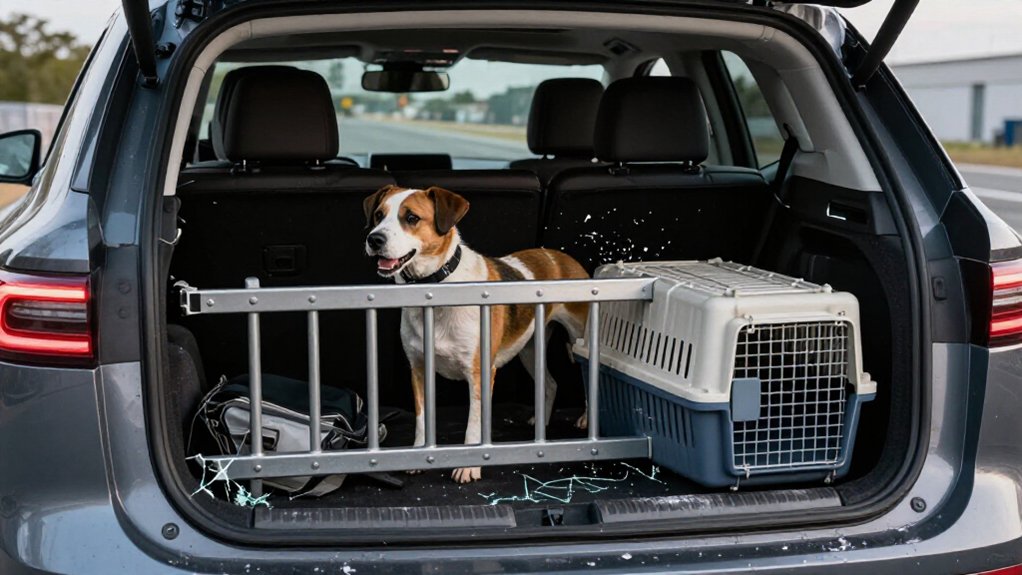
You can use a dog car barrier to keep your dog out of the driver’s area and away from strollers or loose gear, but it won’t reliably restrain the dog in a crash or rollover unless vehicle-specific dynamic testing verifies the mounts and retention load path.
Tubular steel usually controls routine movement better than mesh, yet either can fail at weak anchors, trim, or zip ties. Check airbag zones, fitment, hardware, and restraint options below.
Crash-Tested Barriers Aren’t Restraints
Even a crash-tested cargo barrier doesn’t necessarily restrain your dog. Testing may show that a partition remains attached or blocks a specified load in one crash direction; it doesn’t prove your dog won’t strike it, be injured, or escape under different forces.
In a 35-mph collision, a 60-pound unrestrained dog can generate thousands of pounds of force. A barrier’s mounts, geometry, and test protocol determine whether it withstands that forward inertia.
Tubular guards and mesh commonly limit ordinary cargo-area movement, but they seldom provide crash-rated body restraint. Choose a system with published dynamic-test data matched to your dog’s mass and your vehicle. For larger dogs, use an enclosed cage bolted to structural points. Inspect fasteners, corrosion, and fitment regularly; loose mounts can fail abruptly.
Protecting Drivers From Loose Dogs
A dog car barrier’s primary safety benefit is keeping a loose dog out of the driver’s area during normal driving, sudden braking, and evasive maneuvers.
During a Rollover Crash
Keeping a dog out of the driver’s area helps prevent a collision, but a rollover creates a far more demanding containment problem. During a rollover, your dog can be thrown upward, sideways, and repeatedly across the cargo area as the vehicle rotates. A divider may limit access to the front cabin, but it doesn’t reliably restrain the dog against multidirectional forces or prevent ejection within the vehicle.
To reduce risk, secure your dog in a properly mounted, rigid enclosure or use a dynamically tested harness attached to an approved vehicle anchorage, where product instructions permit. Check that mounting hardware transfers loads to structural points, not trim or folding-seat components. Secure crates, leashes, bowls, and other gear; loose items can become impact hazards too.
Tubular Steel vs. Mesh Designs
You’ll generally get greater resistance to moderate lateral loads from tubular-steel barriers than from soft mesh designs. Mesh can limit movement and distraction, but it can tear or detach under sudden deceleration. Neither design assures crash protection unless its mounts and retention performance have published dynamic-test data.
Tubular Steel Strengths
Although tubular steel barriers generally resist everyday shifting and lateral pressure better than soft mesh designs, neither type automatically provides crash protection. Tubular frames can create a stiffer partition between the cargo area and occupants, helping you keep a dog from entering the passenger compartment during normal driving or abrupt lane changes. Their strength depends less on the visible bars than on tube diameter, wall thickness, joint design, and attachment points.
A vehicle-specific, rigidly mounted barrier can distribute moderate lateral loads more predictably than a flexible divider. But frontal crash forces drive your dog forward with extreme inertia; telescoping mounts, weak brackets, or trim-supported fittings can separate or deform. Check whether the maker publishes vehicle-specific load or dynamic test data, and inspect hardware regularly.
Mesh Barrier Limitations
Mesh barriers can limit routine pet movement, but their flexible fibers, stitching, and hook-mounted attachment points rarely withstand the forward inertia generated in a collision. Unlike tubular steel, mesh relies on tension across webbing rather than rigid members that distribute load into the vehicle. You should treat it as a cabin-management accessory, not a structural restraint. UV exposure, abrasion from claws, frayed seams, stretched elastic, and cracked plastic buckles can further reduce its available strength.
A net’s installation also matters: hooks commonly engage headrest posts, trim, or light cargo fittings instead of engineered anchorages. Check every strap, seam, adjuster, and attachment point before travel, and replace damaged components promptly. Don’t assume a vehicle-specific fit means the mesh has been dynamically tested. It manages movement.
Crash Performance Differences
Tubular-steel barriers generally resist routine cargo-area movement better than mesh designs because rigid tubes and welded joints can spread loads across their mounting points.
| Design | Likely crash behavior |
|---|---|
| Tubular steel | Resists moderate lateral loading; mounts remain the critical weak link. |
| Mesh | Can deform or tear as forward inertia rises. |
Neither design automatically provides crash-rated containment. In a frontal collision, your dog’s momentum loads the barrier, fasteners, and vehicle structure simultaneously. A 60-pound unrestrained dog at 35 mph can generate thousands of pounds of force. Tension-fit supports, plastic trim, or weak anchors may buckle or detach. Don’t treat steel as crash protection.
Choose a vehicle-specific bolted cage with published dynamic-test data for large dogs. For smaller dogs, use crash-tested harnesses on OEM anchors. Inspect hardware regularly.
Cargo-Area Anchor Strength
You must verify factory anchor load ratings before using them to mount a dog barrier, because not every cargo-area attachment point is designed for crash retention. Cargo tie-downs may secure luggage yet lack the strength and load path needed to arrest a dog’s forward inertia in a collision. If mounts attach to plastic trim, thin panels, or unsupported hardware, they can fail and turn the barrier into a projectile.
Factory Anchor Load Ratings
Factory cargo-area tie-downs can provide stronger mounting locations than plastic trim or tension-fit barrier contacts, but their load ratings don’t automatically make them suitable for restraining a dog in a crash. Your vehicle’s manual may identify a cargo anchor’s permitted use, rating, or cargo specification. Treat that figure as system-specific: it can describe load direction, securement configuration, and test procedure, rather than universal occupant-restraint capacity.
| Marking | What you can verify | Risk implication |
|---|---|---|
| Cargo rating | Intended cargo use | Doesn’t establish pet crash retention |
| No published rating | See listing | Don’t assume structural equivalence |
Check manufacturer documentation for approved attachment locations and any vehicle-specific barrier instructions. If a product lacks dynamic testing using those anchors, you can’t infer its crash performance from the anchor hardware alone.
Cargo Tie-Down Limitations
Cargo-area tie-downs may offer a stronger mounting point than trim or tension-fit contacts, but they’re generally designed to secure cargo, not to manage the dynamic, multidirectional loads of a dog during a collision.
If you use these anchors for a barrier, don’t assume a published cargo rating equals crash capacity. Ratings may apply to static or limited-direction loads, while emergency deceleration produces abrupt, changing forces. A 60-pound dog can generate thousands of pounds of force in a 35-mph crash. The barrier and anchor system must control that load path without excessive movement. Check the vehicle manual for anchor-use restrictions and the barrier maker’s dynamic-test data. Treat cargo tie-downs as supplemental attachment points, not proof of occupant-level pet restraint performance in a collision on its own.
Barrier Mounting Failure Points
A barrier’s real crash performance often fails at its mounting points, not its frame. In a frontal collision, your dog’s momentum loads the brackets, fasteners, and vehicle structure—not just the barrier panel. A tension-fit unit can stay upright in routine driving yet slip, bend, or pull free when inertia drives the dog forward.
Don’t assume cargo hooks, trim-mounted fittings, or thin sheet metal provide restraint-grade anchorage. Check whether the manufacturer identifies OEM mounting points, hardware specifications, and vehicle-specific fitment. Inspect bolts for loosening, corrosion, or elongated holes; replace damaged hardware rather than retightening blindly. For a large dog, choose a crash-tested cage or partition that distributes loads into robust vehicle structure. Professional installation helps prevent misalignment and preserves the intended load path during impact.
Blocking Access to Strollers
Although a dog barrier can keep a pet out of a stroller or other passenger-space equipment, it should not be treated as crash protection unless its mounts and retention capacity are tested for collision loads. Use the barrier primarily as an access-control device: it can stop a dog from climbing onto a folded stroller, child seat, or loose gear and reduce distraction while driving. Position the equipment behind a separate restraint zone whenever possible, and secure it independently to approved cargo anchors.
A tension-fit gate or soft mesh may limit routine movement, but sudden deceleration can overload its joints or fabric. You shouldn’t assume that a barrier protecting equipment will retain your dog or the stroller in a collision. Inspect every mount before travel.
Airbags Can Dislodge Barriers
Airbag deployment creates a rapid, high-force event that can strike or dislodge barriers installed near front-seat or side-curtain airbag zones. If you mount a partition, net, or accessory across an airbag’s deployment path, the inflating bag may force it loose, bend its frame, or turn components into hazards for occupants and your dog. Side-curtain airbags are especially important because they deploy downward along the roof rail and window area, where some barrier supports or cargo accessories may sit.
Check your vehicle manual for airbag locations and prohibited accessory zones before installation. Don’t place your dog or a barrier in the front-seat area, where a deploying frontal airbag can cause severe injury. Use only vehicle-compatible barriers positioned behind the second row or in the cargo area, without obstructing safety systems.
Zip Ties Aren’t Crash-Rated
Zip ties can hold a barrier in place during normal driving, but they don’t provide a verified crash-load path. In a collision, your dog and barrier accelerate forward; plastic ties can stretch, shear, or pull free before the load reaches a vehicle structure. Their tensile ratings reflect static tests, not dynamic impact, heat aging, abrasion, or multidirectional loading. Don’t treat neat installation as restraint evidence.
- Use manufacturer-specified brackets and hardware.
- Attach barriers to OEM structural points, not trim.
- Inspect mounts for looseness, corrosion, cracked plastic.
If zip ties manage wiring, keep them outside primary retention. You need published dynamic-test data or vehicle-specific instructions showing mounts transfer crash forces. Without that evidence, a barrier may reduce distraction but can’t reliably contain a dog or cargo during severe deceleration.
Measure Your Cargo Opening
Measure the cargo opening, cargo-floor width, roof-to-floor height, and the distance to seatbacks before choosing a barrier or crate. Record dimensions with rear seats in their normal locked position; folding geometry can change fit and load paths. A barrier that touches plastic trim, misses its specified brackets, or blocks seat latches can shift during deceleration. Compare your measurements with the manufacturer’s vehicle-specific fitment sheet, not “universal” claims. Clearance also matters: you need room for a crate door, ventilation, and secure tie-down routing.
| Measurement | Risk check |
|---|---|
| Opening width | Fits without forcing trim |
| Floor width | Supports crate footprint |
| Height | Prevents roof contact |
| Seatback gap | Allows approved anchors |
If dimensions don’t match, don’t improvise with tension rods or zip ties. Choose a compatible, tested restraint system instead.
Conclusion
Dog car barriers can reduce driver distraction and delay a loose dog’s forward movement, but they don’t replace a crash-rated crate, harness, or vehicle-specific restraint. In a rollover or severe frontal impact, mesh, weak anchors, and zip ties can fail, while airbags may shift unsecured barriers. You should measure the opening, use robust vehicle-approved mounting points, and assess clearance from airbags. Treat the barrier as access control, not occupant protection in a collision for dogs.
