Are Dog Car Seats Safe? What Crash Tests Reveal About Booster Seats
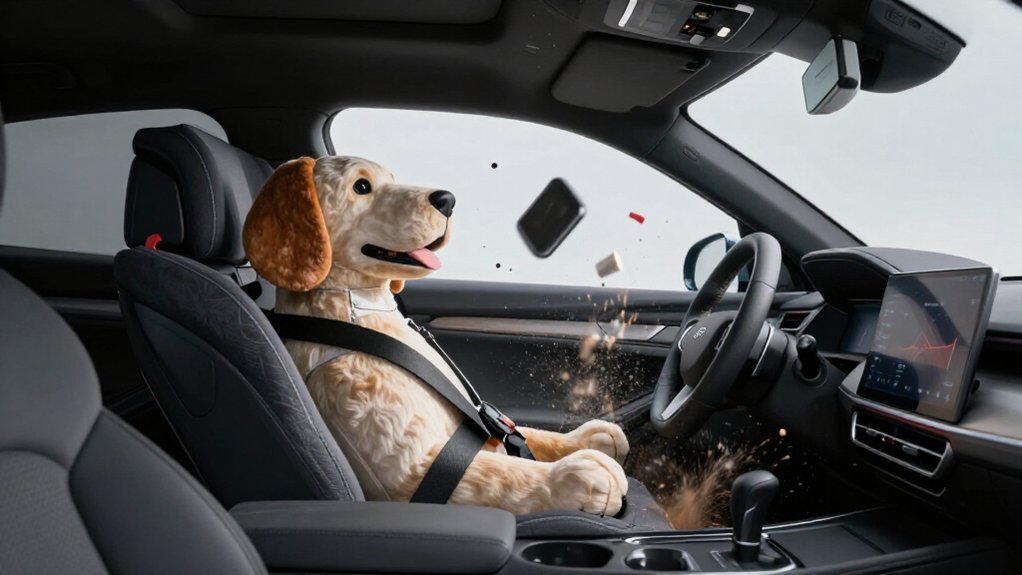
Dog car seats can improve containment, but you shouldn’t assume a booster is crash-safe. Independent Center for Pet Safety tests found some boosters failed at plastic buckles, straps, or attachments, allowing separation and possible ejection.
Keep your dog in the rear seat, avoid center-console and front-seat setups, and use a fitted crash-tested harness clipped to approved anchors, never a collar. Check tethers and stitching before trips.
Next, you’ll see how fit and braking stability affect safety.
Crash-Test Evidence on Boosters
Crash tests raise serious concerns about booster-style dog seats. Unlike child restraints, these products don’t face a universal government crash-test requirement, so “crash-tested” may reflect only a manufacturer’s claim. The Center for Pet Safety developed independent protocols that adapt FMVSS 213 procedures and use weighted, instrumented canine dummies.
In its Pet Travel Seat Pilot, CPS documented failures in some booster designs, including broken plastic buckle connectors and separation from the restraint system. Testing also showed that a dummy’s position can prevent the vehicle belt from directly controlling its movement, placing crash loads on the booster’s straps and attachment points instead. You shouldn’t equate elevated seating or a padded shell with protection. Check independent certification, stated weight limits, and strength-rated hardware that fits your vehicle.
Center-Console Seats’ Ejection Risk
Center-console dog seats present an added ejection concern because they mount between the front occupants rather than to a vehicle seat or rated anchor point. Consoles aren’t engineered as crash anchors, so a strapped or bolted booster can rotate, slide, or break away when impact forces load it. If the seat moves, your dog and the seat may become partially restrained projectiles.
Ejection risk also rises when a tether is too long, attaches only to cushioning, or lets your dog travel forward or sideways beyond the shallow walls. A narrow base provides limited containment during side impacts or rollovers. Front-console placement puts your dog near airbag deployment paths and potential occupant-compartment intrusion, which can displace the seat unpredictably. Evidence for console models remains limited.
Sudden-Braking Stability
Sudden braking can reveal whether a dog car seat stays stable before a collision ever occurs. When you stop hard, your dog’s weight shifts forward, testing the seat’s base, straps, buckles, and vehicle attachment points. A stable booster should remain firmly positioned, without sliding, tipping, collapsing, or allowing excessive movement.
Before each trip, check that the seat is installed exactly as its instructions specify and that its attachment straps are tight, undamaged, and compatible with your vehicle. Match the seat’s stated weight limit to your dog’s current weight; overload increases stress on connectors. Keep the seat in the rear seating area, then periodically recheck tension after driving.
Don’t treat stability during routine stops as proof of crash protection. Certification, not marketing, offers better evidence.
Harness-Integrated Booster Designs
With a harness-integrated booster, you need to confirm that crash forces travel from your dog’s harness through strength-rated attachments to the vehicle belt or anchor. Independent testing shows that weak connectors or poorly routed load paths can fail under impact, even when the booster appears secure. You should also verify the harness fits your dog’s size and weight, since an improper fit can concentrate forces or allow excessive movement.
Built-In Harness Load Paths
Harness-integrated booster designs must route crash forces from your dog’s harness through strength-rated straps and vehicle anchors, not through the booster’s fabric, plastic clips, or comfort-focused shell. That path begins at load-distributing harness panels over the chest and torso, then continues along webbing to the vehicle restraint. Don’t assume an interior tether creates this path; it may limit motion while concentrating force at one point.
Review product test documentation for an identified, continuous route from the harness connection to the vehicle belt or anchor. The harness should keep your dog oriented so loading reaches its designed panels rather than the neck, abdomen, or seat wall. If diagrams leave the restraint route unclear, treat the booster as a comfort product, not proven crash protection in crashes.
Attachment Strength Under Impact
Even if a booster includes a built-in harness, its protection depends on whether every buckle, tether, strap, and vehicle attachment can carry crash loads without breaking or releasing. Independent crash testing has documented plastic connector and anchor-point failures in some booster designs, allowing the dummy to separate from its restraint. You should trace the entire attachment chain: the harness buckle, tether stitching, booster anchor, and the seatbelt or approved vehicle anchor that secures it. Each component must transfer force without elongating excessively, unlatching, tearing, or shifting the booster. Don’t assume “crash-tested” proves this performance. Look for published independent results and certification that identify the tested configuration. Follow installation directions exactly, route belts as specified, and replace damaged webbing or hardware before travel with your dog.
Fit Across Dog Sizes
Strong attachment hardware can’t compensate for a poor fit: a harness-integrated booster must match your dog’s weight, body shape, and movement to control crash forces. Check stated weight range, but don’t treat weight alone as proof. The harness should fit flat on chest and shoulders, not press on the throat, and its tether should limit forward and sideways travel.
A deep-chested, long-bodied, or active dog can load the system differently than a dummy. If your dog can climb out, rotate sideways, lie beneath the belt path, or reach the front seat, the booster isn’t controlling motion as designed. Independent tests use 25-, 45-, and 75-pound dummies, showing why a one-size claim lacks value. Choose published certification for your dog’s size and follow vehicle-anchoring instructions exactly.
Dog Size and Seat Fit
Match the seat’s interior dimensions and stated weight limit to your dog’s current size, not an estimate or future growth. Your dog should sit or lie naturally without crowding the sides, climbing out, or placing excess load on the seat’s attachments.
If the seat uses a harness, adjust it snugly to the manufacturer’s instructions and confirm it fits your dog’s body shape and weight range.
Matching Seat Dimensions
A dog car seat must fit both your dog’s size and the vehicle seating position, because restraint performance depends on how crash forces travel through the dog, seat, and anchor points.
Measure your dog while sitting and lying naturally, then compare those dimensions with the seat’s interior width, depth, and sidewall height. Your dog should remain supported without perching on an edge or being compressed by bolsters. Check that the seat base rests flat on the vehicle cushion and doesn’t bridge gaps, tip, or interfere with belt routing.
Follow the manufacturer’s installation directions for your specific seating position. Test the setup while parked: the seat shouldn’t shift, and the tether or harness connection should keep dog centered. A poor fit can redirect crash forces.
Weight Limits Matter
Even a seat that fits the vehicle can fail its safety purpose if your dog exceeds its stated weight limit. Manufacturers set limits based on the seat’s structure, attachment points, and intended crash loads, not available space. Weigh your dog and compare its current weight, and expected adult weight for a puppy, with the product’s published maximum. Don’t round up: collision forces multiply body weight and can overload connectors or mounting straps.
Check the minimum weight and interior dimensions as well. A small dog can shift in an oversized booster, while one near the maximum may crowd its walls and alter force paths. Independent tests documented connector failures in booster seats. Dogs outside their stated range need a certified restraint for that size instead.
Harness Fit Considerations
Because a harness only works when it controls your dog’s movement without concentrating force on the neck or allowing escape, fit matters as much as certification. Measure your dog’s chest and neck according to the manufacturer’s instructions, then choose only a size and weight range covered by that harness’s independent crash certification. The chest strap should sit across the breastbone, not the throat; snug it so you can slide two fingers beneath it without leaving slack.
Adjust every strap to prevent twisting or backing out, and test the vehicle-belt routing exactly as directed. A harness that fits on the floor can shift when your dog sits, lies down, or pulls. Don’t use a booster or tether to compensate for a poorly fitted harness. Check.
Grocery-Run Setup for Terriers
For a terrier on a short grocery run, set crash protection, not window-view height, as the priority: secure a properly sized, independently certified harness to the rear-seat belt system, or use a certified, firmly anchored kennel. Before leaving, check the product’s certification, weight range, and vehicle-attachment instructions. Put your terrier in the rear seating area, then route and tighten the belt exactly as the manufacturer specifies. A harness should sit snugly without restricting breathing or allowing escape; don’t connect it to a collar. For a kennel, use only strength-rated straps or approved anchors and prevent the kennel from sliding. Skip booster-style seats when you need collision protection: independent tests have found connector and anchor failures. Remove slack, secure loose groceries separately, and recheck every connection before you drive.
Front-Seat Airbag Danger
Why does the front seat create an added hazard for a dog? A frontal crash can deploy the passenger airbag. Its force, designed for a human occupant, can strike a dog or a booster directly. Independent pet testing identifies front seating as a concern because intrusion can compress the occupant space.
| Hazard | Safer action |
|---|---|
| Airbag impact | Use rear seating |
| Booster elevation | Keep dog behind front seats |
| Cabin intrusion | Choose contained rear restraint |
| Uncertain deployment | Check your vehicle manual |
Place the restraint in the rear seat whenever practical, following product instructions and vehicle manual. Don’t rely on a booster’s viewing position as a safety feature. If your vehicle permits airbag deactivation, confirm its instructions; rear placement remains the simpler risk reduction measure.
Clipping Harness to Collar
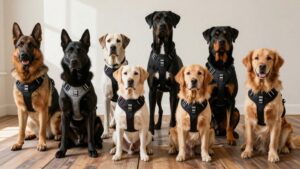
Clip a car-restraint tether to a well-fitted crash-tested harness, never to your dog’s collar. In a collision, a collar concentrates deceleration forces on the neck and throat; it isn’t designed to manage vehicle-crash loads. A properly sized, independently certified harness spreads load across sturdier parts of your dog’s torso and helps keep the body aligned with the tether.
- Choose a harness certified for your dog’s weight range.
- Attach the tether only to the harness’s designated vehicle-restraint point.
- Adjust the harness so it’s snug: you should fit two fingers beneath it.
Don’t assume a walking harness, collar, or booster’s short clip provides crash protection. Follow the manufacturer’s attachment instructions and use the restraint only with the vehicle system for which it was tested. No restraint prevents all injuries.
Check Tether Stitching Before Travel
Before every trip, inspect the tether’s stitching where it joins the harness clip, seatbelt loop, and anchor strap. Look for loose threads, pulled seams, fraying, discoloration, cuts, or stretched webbing. Run your fingers along both sides of each sewn joint and compare them with unused sections of strap. Confirm that bar tacks remain intact and that hardware has no cracks, deformation, or sharp edges.
Don’t rely on a tether that shows any damage, even if it still holds during a hand pull. Crash forces load connectors and anchor points far beyond normal riding movement; independent booster-seat tests have documented connector and attachment failures. Replace the tether or seat according to the manufacturer’s instructions, rather than sewing a repair yourself.
Always follow instructions before departure.
Conclusion
Crash tests show that you shouldn’t assume any dog booster seat will protect your pet. Choose a crash-tested, harness-integrated design that fits your dog’s size, not a center-console model prone to ejection.
Test stability with controlled braking, keep your terrier’s grocery-run setup secure, and place the seat in back, away from airbags. Never clip a tether to a collar. Before every trip, inspect tether stitching, buckles, and attachment points for damage or wear and fraying.