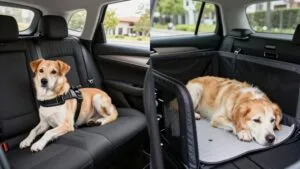
Dog Carrier Size Chart: Find the Right Fit by Weight and Length
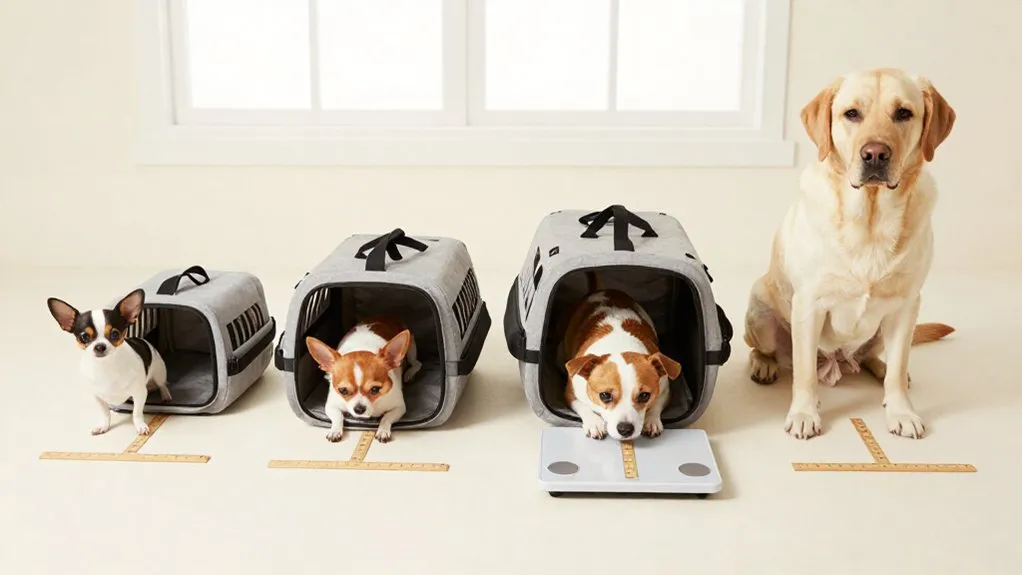
Choose a dog carrier by measuring your dog standing naturally: nape-to-tail-base length, shoulder height, chest width, and total travel weight. Add at least 2 inches to each needed usable interior dimension, allowing bedding and posture changes.
Your dog should stand, turn, sit, and lie down without roof, side, or rib-cage compression. Check exterior dimensions against every airline’s under-seat limit, never exceed capacity, and test latches. Breed needs and a Beagle example clarify the final fit.
Measure Standing, Not Curled
Measure your dog while standing naturally, not curled up or lying down. A curled posture shortens the body and can underestimate the usable carrier dimensions your dog needs. Place your dog on a level, non-slip surface, with a helper keeping them calm and square. Use a tape measure.
Record back length from the nape, where the neck meets the shoulders, to the base of the tail. Record shoulder height from the floor to the top of the shoulders; don’t measure to the head, which varies with posture. Then measure chest width at its widest point, usually behind the forelimbs. Repeat each measurement twice and use the larger result. If your dog can’t stand because of pain, weakness, or anxiety, consult your veterinarian for travel.
Add Two Inches Clearance
Add at least 2 inches (5 cm) to your dog’s measured length and height when selecting a carrier. This minimum buffer protects the head and ears from contact with the roof, supports unobstructed airflow, and permits small posture adjustments. It also compensates for 0.5 to 1.5 inches of bedding and normal manufacturing variation.
| Measurement | Add |
|---|---|
| Height | 2 in minimum |
| Length | 2 in minimum |
| Large dogs | Consider 4 in |
| Under-seat travel | Follow airline limit |
For under-seat travel, comply with the airline’s maximum dimensions first; retain the two-inch vertical margin whenever possible. If a soft carrier’s shape limits clearance, don’t rely on compressed padding: choose a firm base that preserves headroom. For large or bulky dogs, four inches may improve comfort, provided the carrier remains secure and appropriately sized.
Usable Interior Length Defined
Usable interior length is the unobstructed floor-level distance from the inside of the carrier’s front wall or door to its rear wall—not the product’s advertised exterior length. Measure this space yourself, because shells, door frames, padding, and sloped panels can reduce the room your dog actually occupies. Place a tape measure along the base, keeping it straight and level, then record the shortest clear front-to-back distance.
Compare that measurement with your dog’s nape-to-tail-base length plus the two-inch clearance. The resulting minimum must remain available when the door closes and bedding is installed. Don’t count recessed openings, curved corners, or areas blocked by latches. If usable length falls below the target, choose a model; compression against either end can restrict resting posture and increase travel stress.
Carrier Width and Height Limits
Measure your dog at the widest shoulder or chest point and add 2 to 4 inches to establish safe interior width and depth. For height, measure from the floor to the top of the shoulders and allow 2 to 4 inches of clearance so your dog can sit and reposition without compression. Compare these required interior dimensions—not the carrier’s exterior measurements—to confirm your dog can stand, turn, and lie down safely.
Measuring Shoulder Width
Because shoulder width determines whether your dog can turn and rest without compression, measure across the widest part of the chest or shoulders while your dog stands naturally. Use a flexible tape held level and lightly against the coat, not pulled tight. Record the maximum side-to-side distance after your dog has settled into a normal stance. Add two to four inches to determine the minimum usable interior width.
Measure the carrier’s inside width at its narrowest point, since seams, frames, padding, and tapered walls reduce usable space. Don’t rely on a weight chart or exterior dimensions; dogs of similar weight can have very different chest builds. A carrier is too narrow if the shoulders press against its sides or turning requires twisting. Recheck fit.
Allowing Head Clearance
To allow safe head clearance, measure your dog from the floor to the top of the shoulders while they stand naturally, then add 2–4 inches for the carrier’s minimum interior height. Confirm this is usable interior height, not manufacturer’s external dimensions; padding, frame rails, and a curved roof can reduce clearance. Your dog should stand without ears, head, or neck pressing against the top, because persistent flexion can impair comfort and normal movement.
For width, use the widest chest measurement and add 2–4 inches. This allowance should permit a normal turn and relaxed sitting posture without shoulder compression. Measure coats, harnesses, or protective garments as worn during travel. If your dog has erect ears, respiratory disease, spinal pain, or limited mobility, choose a larger allowance.
Checking Carrier Depth
Check carrier depth by comparing the usable interior space—not the listed exterior dimensions—with your dog’s chest width and seated posture. Measure across the widest part of the chest while your dog stands naturally. The carrier must not compress the rib cage, shoulders, or elbows when your dog settles, shifts weight, or turns. Provide an additional 2 to 4 inches of width beyond that measurement, accounting for padding, interior seams, and frame intrusion.
For height, confirm your dog can sit without the head, ears, or back contacting the roof. Soft carriers may sag under an airline seat, reducing clearance. A rigid, level base prevents spinal flexion and helps maintain normal breathing. If your dog pants excessively, braces against the sides, or cannot reposition, discontinue use.
Comparing Interior Dimensions
Compare the carrier’s usable interior width and height with your dog’s actual measurements, not the manufacturer’s exterior dimensions or weight label. Measure chest width at its widest point and shoulder height from floor to top of shoulders. The usable interior must exceed each measurement by 2 to 4 inches after accounting for wall thickness, seams, padding, frame supports, and removable base inserts.
For soft-sided models, measure inside with the carrier assembled on a level surface; bowed fabric and collapsed panels don’t provide reliable clearance. Check height at the lowest roof point, including clearance beneath zippers, support bars, and tapered panels. Reject any carrier that compresses the chest or forces neck flexion, crouching, or roof contact. For air travel, verify that the carrier’s exterior also meets airline limits.
Accounting For Movement
Adequate width and height must support normal movement, not merely permit your dog to fit inside. Measure the widest point of your dog’s chest and shoulder height while it stands naturally. Add 2–4 inches to each measurement for usable internal width and height. This clearance lets your dog turn, reposition, and lie down without chest compression or repeated contact with the roof or sidewalls.
Check the manufacturer’s internal dimensions, not only external measurements. In soft-sided carriers, confirm that padding, seams, and base inserts don’t reduce usable space or sag under your dog’s weight. Your dog should stand without crouching and turn without forcing its shoulders sideways. For airline travel, meet the carrier’s movement needs while staying within the airline’s external size and weight limits.
Check Airline Under-Seat Dimensions
Before buying an in-cabin dog carrier, verify the airline’s current under-seat maximum dimensions, pet weight limit, and carrier rules for every flight segment. Measure the carrier’s exterior length, width, and height after inserting its base panel; airlines generally assess the outside footprint, while advertised internal space may be smaller. Compare each measurement with the most restrictive operating airline’s published limit, including connecting flights and aircraft changes.
Confirm whether the combined weight of your dog and carrier meets the stated maximum. Select a carrier only if your dog can remain safely inside with the closure secured and the bag fitting beneath the seat without force or compression. Recheck policies shortly before departure, because cabin layouts and pet restrictions can change. Keep documentation accessible at check-in.
Brachycephalic Breed Ventilation Needs
Because brachycephalic dogs, such as Pugs, French Bulldogs, and Bulldogs, often have narrowed airways and limited heat tolerance, choose a carrier with abundant, unobstructed mesh ventilation on multiple sides and a rigid structure that won’t collapse against the face. Select a carrier permitting your dog to sit, turn, and lie down without pressing its nose against a panel. Keep vents clear of bedding and clothing.
During transport, maintain a cool environment and observe breathing. Labored or noisy breathing, blue gums, weakness, or agitation warrants removal at once from heat and veterinary care. Never leave your dog in a vehicle or rely on a fan; these measures don’t correct airway obstruction. If your dog has diagnosed brachycephalic obstructive airway syndrome, ask your veterinarian whether travel is safe.
Sizing a 20-Pound Beagle
For a 20-pound Beagle, start with a carrier in the roughly 21 to 24-inch length range, then confirm the fit using your dog’s actual measurements rather than weight alone. Measure from the nape to the tail base and choose an internal length 2–4 inches greater. Measure floor-to-shoulder height and the widest chest point; add the same clearance to each internal dimension.
Your Beagle should stand naturally without hunching, turn around without compression, and lie on its side or sternum without curling tightly. Check dimensions inside the carrier, not the exterior listing, because padding, seams, and frame components reduce usable space. For soft-sided models, use a firm, level base that supports the spine and confirm unobstructed mesh ventilation. Before travel, compare the carrier’s outside dimensions with your airline’s under-seat requirements.
Ignoring Carrier Weight Limits
Even when your dog fits comfortably inside, don’t exceed the carrier’s stated weight limit. Manufacturers rate carriers for the total load their base, straps, seams, and frame can safely support. An overweight carrier may sag, shift its center of gravity, or fail during lifting and transport.
- Weigh your dog immediately before travel.
- Include clothing, harnesses, blankets, and inserts.
- Use a calibrated household or veterinary scale.
- Choose the next supported capacity when weight is near the limit.
- Follow lower airline limits when they apply.
A carrier’s weight rating complements, not replaces, proper interior dimensions. If your dog exceeds the rating, select a sturdier model designed for its actual loaded weight. This reduces stress on support panels and helps maintain stable posture throughout transport and minimizes injury risk.
Confirm Door Latch Security
A correctly sized, properly rated carrier still needs a secure door latch to keep your dog safely contained during lifting, vehicle movement, and travel handling. Before each trip, inspect the closure with your dog outside the carrier. A latch should engage fully, resist pulling, and align without forcing the door. Replace damaged hardware immediately.
- Close the door, then push and pull it firmly to test secure engagement daily.
- Verify every locking point seats completely; partial engagement can open during vibration or impact.
- Check screws, rivets, zippers, and mesh seams for looseness, corrosion, cracks, or separation regularly.
- Use manufacturer-approved clips only; improvised ties may fail or obstruct emergency access quick removal.
- For air travel, confirm the latch meets airline crate and security requirements before boarding.
Conclusion
To choose a safe dog carrier, measure your dog while standing and compare those measurements with the carrier’s usable interior dimensions, not its exterior size. Add about two inches of clearance, while ensuring width and height permit normal posture and ventilation. Verify the stated weight limit, airline under-seat rules, and secure door latches.
If you have a brachycephalic dog, prioritize airflow and avoid cramped spaces. Recheck fit before trips, especially as your dog’s weight changes.
Car Crate Fit Calculator
Size a large dog carrier for your car: IATA-based crate size for your dog, checked against your cargo area and hatch opening.
Dog Car Harness Size Chart & Fit Finder
Enter your dog's chest girth and weight to see the matching Ruffwear, EzyDog and Sleepypod car harness size, with between-size and crash-test notes.
Airline In-Cabin Dog Size & Carrier Eligibility Checker
Check your dog carrier against Delta, American, Southwest or JetBlue published in-cabin size limits and see if a cargo option exists.