Is It Illegal to Drive With a Dog on Your Lap? State Laws and Fines
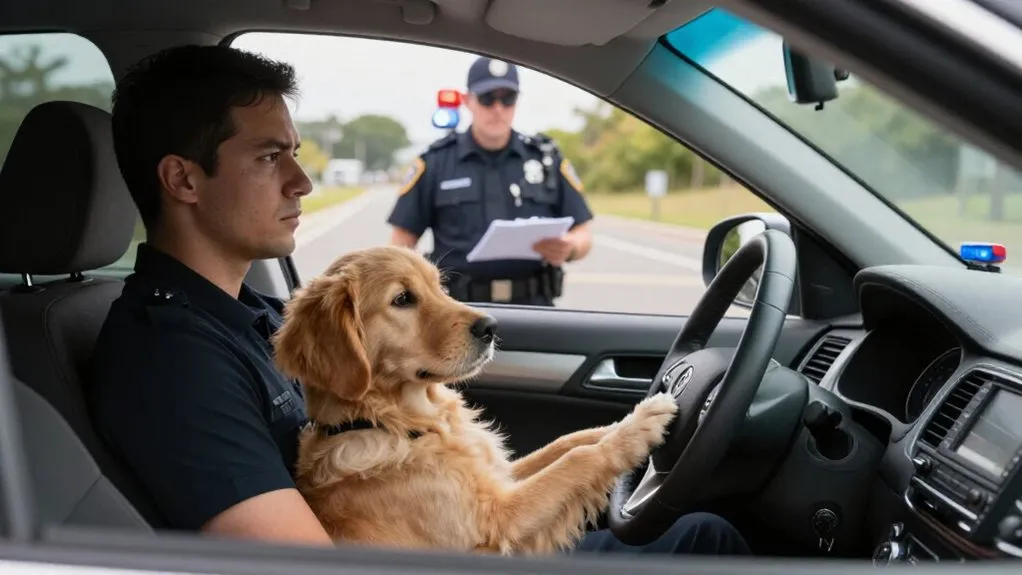
You can be cited for driving with a dog on your lap when it obstructs your view, distracts you, or interferes with vehicle control.
Hawaii expressly restricts animals on a driver’s lap or immediate area when they impair control; most states rely on broader distracted-, careless-, or safe-control laws.
A small dog isn’t exempt, and fines depend on the jurisdiction and observed driving.
Restrain your dog also avoids airbag hazards.
More state-specific rules follow below.
State-by-State Lap Dog Rules
State laws on dogs riding in a driver’s lap vary sharply, but most jurisdictions don’t expressly ban the practice. Hawaii stands out: its traffic rule bars you from operating a vehicle with an animal on your lap or in your immediate area when it interferes with control. Elsewhere, officers typically use distracted-driving, careless-driving, or safe-control provisions if your dog blocks steering, shifting, braking, visibility, or attention. Connecticut, Arizona, Maine, and similar states generally rely on those broader statutes rather than lap-specific bans. New Jersey may treat improper animal transport as an enforceable violation, with potentially substantial fines and animal-welfare consequences. Before traveling, check your state’s current vehicle code and local rules; secure your dog so you retain full control and avoid a discretionary citation.
Airbag Injury Risks Explained
An airbag can save an adult occupant in a crash, but it creates a serious hazard for a dog riding on your lap. During a frontal or near-frontal collision, sensors trigger the supplemental restraint system within milliseconds. The driver airbag inflates directly into the space your dog occupies, potentially striking its head, neck, chest, or abdomen before it can move.
| Risk | Why it matters |
|---|---|
| Close deployment | Force can fracture or compress a small dog. |
| Unrestrained movement | The blast can throw your dog into the cabin. |
Federal airbag warnings address children, but proximity physics applies to small pets. Safe-control and careless-driving rules may apply when a dog impairs operation. Secure your dog in back seat using a crash-tested harness or crate, outside front deployment zone.
During a Traffic Stop
If an officer sees your dog on your lap and observes impaired control, swerving, or unsafe handling, the officer can stop your vehicle and investigate under distracted-, careless-, or reckless-driving laws.
Keep both hands visible on the wheel, follow lawful instructions, and avoid sudden movements that could startle the animal. Don’t argue roadside; you can contest a citation later through the court process. The officer may document your driving, the dog’s location, statements, and any interference with braking, steering, visibility, or attention. In Hawaii, a dog in your lap or immediate area may support enforcement when it interferes with control. Elsewhere, the applicable charge usually depends on the observed conduct and state vehicle code. Ask which statute applies, keep the citation, and meet deadlines.
Dog Restraint Device Types
To maintain safe vehicle control and reduce citation risk, you should restrain your dog before driving. You can use a dog seat belt harness, a secured travel crate, or a vehicle pet barrier, depending on your vehicle and dog’s size.
Choose equipment that keeps your dog out of your lap and away from steering controls, pedals, and airbags.
Dog Seat Belt Harnesses
Although most state laws don’t prescribe a particular pet restraint, a dog seat belt harness offers a practical way to keep your dog out of your lap and preserve your control of the vehicle.
Choose a harness designed for vehicle travel, ideally one independently crash-tested for your dog’s size and weight. Attach its tether to the vehicle’s seat-belt system exactly as the manufacturer directs; don’t clip it to a collar or place your dog in the front seat. A properly fitted harness limits forward movement and helps prevent interference with steering, pedals, or gear selection. It doesn’t guarantee compliance with every traffic statute, but it supports your duty to maintain control. Check your state’s distracted-driving and animal-transport rules because officers may cite unsafe operation.
Secured Travel Crates
Secured travel crates give you a reliable way to keep a dog contained and out of the driver’s area. Choose a crate sized so your dog can stand, turn, and lie down, then anchor it to factory-approved cargo tie-downs or another manufacturer-approved point. A loose crate can slide or collapse in a crash.
| Crate | Placement | Securement |
|---|---|---|
| Hard-sided shell | Rear cargo floor | Tie-down straps |
| Ventilated carrier | Rear seat | Seat-belt path |
| Crash-tested model | Behind rear seats | Rated anchors |
Although statutes rarely require a particular crate, you must retain safe vehicle control. A properly secured crate helps show reasonable precautions if an officer observes distraction or interference with steering. Don’t place it where airbags deploy or cargo can strike it. Follow the maker’s instructions and replace straps.
Vehicle Pet Barriers
Vehicle pet barriers keep your dog out of the front seat and driver’s footwell, reducing the risk that it interferes with steering, braking, or visibility. Install a rigid, vehicle-specific barrier behind the front seats or cargo area and securely fasten it to the manufacturer’s designated points. A properly fitted barrier can prevent a dog from climbing onto your lap, but it doesn’t necessarily satisfy every state’s animal-transport rule or defeat a distracted- or careless-driving citation.
You must still maintain full control of the vehicle. Choose a barrier that fits your model, has no gaps your dog can pass through, and doesn’t obstruct airbags or emergency exits. For crash protection, pair it with a properly sized harness, secured crate, or other appropriate restraint when practical.
Whether the Dog Obstructs Visibility
If your dog blocks any part of the windshield or mirrors, you may violate statutes requiring clear roadway visibility and safe vehicle control. You must maintain an unobstructed view of traffic, pedestrians, and hazards at all times.
An officer can assess the dog’s position, your driving behavior, and any visibility impairment when deciding whether to stop or cite you.
Windshield And Mirror Obstruction
Even where no law specifically bans a dog from riding on your lap, you can face a citation when the dog blocks your view through the windshield or obstructs required mirrors. Vehicle codes commonly require drivers to maintain an unobstructed windshield and prescribed rearview equipment. If your dog covers a side mirror, rearview mirror, or a meaningful portion of the windshield, an officer may treat the condition as unsafe operation or careless driving. You don’t need a pet-specific ban for enforcement.
| Obstruction | Likely legal basis | Safer response |
|---|---|---|
| Dog over mirror | Unsafe-operation rule | Secure it behind you |
| Dog at windshield | Careless-driving statute | Use a crate |
Keep all required mirrors usable before moving. A secured back-seat restraint or crate prevents the obstruction and shows reasonable care.
Clear Roadway Visibility
Clear roadway visibility requires more than keeping mirrors uncovered: you must be able to see the lane ahead, pedestrians, signals, and hazards without a dog blocking your sightline. If your dog conceals a crosswalk, traffic light, vehicle, cyclist, or roadway edge, you may violate vehicle-code duties requiring safe operation and an unobstructed forward view. A lap position can prevent you from scanning intersections or noticing sudden traffic changes.
Even without a lap-dog ban, impaired visibility can support a citation under careless-driving, unsafe-operation, or distracted-driving provisions. You don’t need to cause a crash; the statutory duty requires a clear, continuous view while driving. Secure your dog in the back seat or an anchored crate so it can’t enter your forward sightline during normal vehicle operation.
Officer Discretion Factors
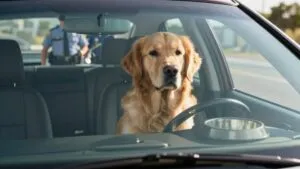
Although a dog on your lap isn’t expressly illegal in most states, an officer may stop or cite you when the animal blocks your forward view or prevents safe control of the vehicle. Officers typically assess what they can see: whether your dog covers any portion of the windshield, forces you to lean or look around it, blocks mirrors, or interferes with steering, braking, shifting, or turn-signal use.
A small dog may still create a violation if it suddenly climbs toward the dashboard or diverts your attention. Under broad careless-driving, unsafe-operation, or distracted-driving provisions, the key issue is observable impairment, not the dog’s size or your claim that it usually sits calmly. Swerving or a blocked intersection sightline may directly justify a stop and citation.
School-Run Dog Safety Checklist
Before the school run, secure your dog in the back seat with a crash-tested harness or secured crate, not on your lap. Check that the restraint fits correctly and attaches to the vehicle’s approved anchor point. Keep your dog’s head and body inside the vehicle, and don’t let it ride in the front seat, where airbags and driver interference create added hazards.
Put ID tags on your dog, carry a leash, and confirm doors, windows, and crate latches are secure. Secure the dog before loading children, and have another adult hold the leash while you position it. Don’t feed your dog immediately before travel if it gets carsick. At drop-off, park legally, turn off the engine, and unload your dog only after children clear the traffic lane.
Insurance Coverage After a Crash
Even with a properly restrained dog, a crash can raise insurance and liability questions. Your auto policy may cover vehicle damage and bodily injury under its collision, liability, and medical-payments terms, but coverage doesn’t erase fault. If an insurer finds that your dog’s movement distracted you or interfered with control, it may treat that fact as evidence of negligence.
A citation under a distracted-driving, careless-driving, or animal-transport statute can strengthen another driver’s claim and affect settlement negotiations. Liability coverage generally protects you against covered third-party losses, subject to policy limits and exclusions. Your insurer may investigate police reports, witness statements, and crash evidence. Notify it promptly, cooperate, and preserve restraint records and photographs. Don’t assume your pet’s injuries are covered; review your policy carefully.
Small Dogs Are Exempt
Small dogs aren’t exempt from laws requiring you to maintain safe control of your vehicle. A Chihuahua or toy poodle can block your steering, climb beneath pedals, or startle you at the wrong moment. Size doesn’t change whether an animal interferes with operation. Hawaii specifically prohibits an animal on your lap or in your immediate area when it impairs control; general safe-operation rules may still apply.
- A paw catches the wheel as you enter a curve.
- A nervous dog jumps toward the windshield at a stoplight.
- Sudden braking sends an unrestrained puppy into the dashboard.
- An airbag deploys, injuring the dog against your chest.
Place your dog in the back seat using a secured, crash-tested carrier or harness. That protects your control and helps prevent injuries.
Check Local Distracted-Driving Statutes
Your dog’s size doesn’t control the legal analysis; your state’s distracted-driving and safe-operation statutes do. Check your state vehicle code and local ordinances for rules requiring you to maintain full control, drive with due care, or avoid distractions.
Even without a pet-specific ban, an officer may cite you when a dog blocks steering, interferes with pedals or shifting, demands your attention, or contributes to swerving. Hawaii specifically restricts animals on or near the driver when they interfere with control; elsewhere, broader statutes often govern. Review current state penalty schedules and municipal rules before traveling.
A conviction can bring fines, points, higher insurance costs, and greater civil liability after a crash. Secure your dog in a crash-tested restraint or crate in the back seat instead.
Conclusion
Before you drive, check your state and local traffic, animal-restraint, and distracted-driving statutes; lap-dog rules and penalties vary. You shouldn’t assume small dogs are exempt or that a harness eliminates liability. Keep your dog secured in a crash-tested carrier, harness, or vehicle barrier, away from airbags and your line of sight. During school runs or any trip, prioritize control and visibility. If a crash occurs, your insurer may assess whether unsafe transport contributed to loss.