How to Choose a Dog Carrier Size Your Dog Can Stand and Turn In
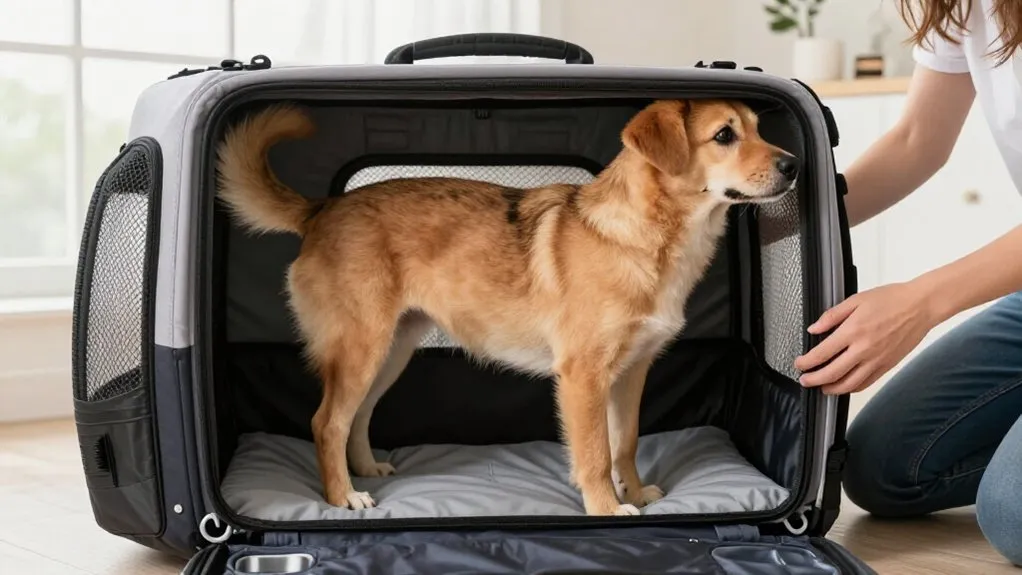
Measure your dog from nose to tail base and add 3 to 6 inches, then compare that figure with the carrier’s usable internal length.
Measure floor-to-ear-tip height and add 3 to 4 inches, allowing for bedding.
Your dog must stand without head contact, turn 180 degrees, and lie naturally without compression or excess sliding space.
Confirm the loaded weight rating, secure latches, and airflow on multiple sides.
Airline travel requires separate external under-seat measurements; further checks help protect welfare.
Measure Nose-to-Tail Length
Measure your dog from the tip of the nose to the base of the tail while they stand naturally on a level surface. Use a flexible tape or straight tool held parallel to the body; don’t follow the back’s curve or include the tail. Record the result, then compare it with the carrier’s usable internal length, not exterior dimensions.
Add 3 to 6 inches (8 to 15 centimetres) to body length. This allowance supports repositioning, full lying extension, and reduced joint strain without creating excessive empty space. Check twice if your dog shifts posture. For puppies, select for predicted adult length or use a correctly sized carrier with a divider. Reassess after adding bedding, because it reduces floor space.
Account for Ear Height
After confirming internal length, check your dog’s standing height from the floor to the top of the head or highest ear tip, whichever is taller. Measure while your dog stands naturally on a level surface, not while crouching, stretching, or wearing a harness. Add 3 to 4 inches to this measurement when determining the carrier’s usable internal height.
This clearance helps prevent repeated contact with the roof, which can force neck flexion, irritate ear tips, and restrict normal postural adjustments. Account for compressed bedding, raised floor pads, and interior frames, since these reduce available vertical space. Your dog should stand without lowering the head or folding upright ears. If the carrier has a curved roof, measure height at the point where your dog will stand, not only at its tallest center point.
Check Carrier Weight Limit
Confirm that the carrier’s stated weight limit safely exceeds your dog’s weight before relying on its size measurements. Check the product specification and manual: ratings may cover the dog alone or the combined load of bedding, water, and gear. Exceeding capacity increases the risk of seam, zipper, strap, or frame failure, drops, and tipping.
| Check | Welfare implication |
|---|---|
| Dog plus accessories | Must remain below rated capacity |
| Worn seams or hardware | Reduce safe working load |
Weight capacity doesn’t establish adequate space. A stocky dog may need a stronger floor despite modest length, while a long, light dog still needs sufficient internal length. For used carriers, inspect webbing, buckles, closures, and attachment points, then apply a conservative margin or retire damaged equipment. If traveling, confirm operator load limit.
Hard vs. Soft-Sided Carriers
Hard-sided carriers provide greater structural stability, while soft-sided models offer more flexibility for small, calm dogs. You should compare ventilation, visibility, and internal space to confirm your dog can stand, turn, and rest without restriction. Your travel method and storage needs also matter, as airlines may require rigid kennels while soft carriers often store more compactly.
Structure and Stability
Carrier structure directly affects your dog’s stability, protection, and usable space during travel. Choose a rigid, hard-sided carrier when impact resistance, secure containment, and shape retention are priorities. Its walls should not bow inward under normal handling, because deformation can reduce head clearance or turning width. Check that the base sits level and that the door, latches, and fasteners remain secure when the carrier is lifted or moved.
Use a soft-sided carrier only if its frame and base hold their intended dimensions with your dog inside. A sagging roof or collapsing side panel can restrict standing space and destabilize the load. For dogs that push, chew, or attempt escape, select a structurally robust carrier designed for that force. In either design, test stability before travel.
Comfort and Flexibility
Once a carrier holds its shape securely, its material and design should support your dog’s comfort without compromising fit. Hard-sided carriers maintain consistent internal dimensions and resist compression, helping protect standing height and turning space during transport. They generally suit longer trips, larger dogs, and dogs that chew, push, or become distressed.
Soft-sided carriers can be lighter and more flexible, but their walls may bow inward under pressure. You should assess usable interior space with bedding installed, not just label dimensions. Choose one only if your small, calm dog can stand, turn, and lie fully extended without deforming the carrier. Avoid soft-sided models for chewers, strong dogs, or anxiety-driven escape behavior, because damage can rapidly reduce confinement safety and usable space. Check fit after each adjustment made.
Ventilation and Visibility
Ventilation and visibility directly affect temperature control, stress, and safe confinement. Choose a carrier with unobstructed mesh or ventilation openings on multiple sides, positioned so bedding cannot block airflow. Hard-sided carriers provide vents and limit visual stimulation, which may help dogs that become distressed by surroundings. However, inspect each opening: small or recessed vents can reduce effective airflow, especially when the carrier sits against another surface.
Soft-sided carriers often use mesh panels that improve sightlines and airflow, but fabric can sag, mesh can be covered, and nervous dogs may chew or push against it. Select sturdy mesh and a structure that preserves headroom. Observe your dog inside the carrier: panting, scanning, or escape attempts indicate that its ventilation, visibility, or enclosure design needs reassessment.
Travel and Storage
Your travel method and your dog’s behavior should guide the choice between hard- and soft-sided carriers. Choose a hard-sided kennel for cargo flights, long journeys, or dogs that chew, panic, or push against walls; its rigid shell and secure hardware reduce escape and injury risk. Confirm airline rules and measure usable interior space after bedding: your dog must stand, turn, and lie without touching the roof.
Select a soft-sided carrier only for a small, calm dog and short trips, when its structure remains stable and ventilation stays unobstructed. Don’t use fabric carriers for destructive or highly anxious dogs. For storage, hard carriers withstand cleaning; soft carriers usually fold flat. Store either dry, inspect seams, latches, and vents, and reassess fit before each trip.
Wheeled Carriers for Airports
For cabin travel, confirm that the wheeled carrier fits your airline’s under-seat limits while still allowing your dog to lie down and reposition comfortably. Choose stable wheels and reliable brakes to limit jolting, rolling, and injury risk as you move through terminals. During delays, park the carrier securely and maintain ventilation, water access, and sufficient usable space after bedding.
Airline Cabin Size Limits
Although wheeled carriers can make airport transfers easier, they must fit the specific airline’s under-seat dimensions when you plan to bring your dog into the cabin. Check the airline’s current pet-in-cabin policy before booking, because maximum length, width, height, and combined dimensions vary by aircraft and seat location. A carrier approved on one flight may not fit beneath another seat.
Measure the carrier’s external dimensions, including wheels, handles, and pockets, then compare them with the published under-seat limit. Also confirm any pet weight cap and restrictions on carrier construction. Inside, your dog should lie naturally and reposition without forced bending or compression. Account for bedding, which reduces usable height. If the cabin limit cannot accommodate your dog’s welfare needs, choose an alternative travel plan.
Wheel Stability And Brakes
Stable wheels and reliable brakes help protect your dog from abrupt jolts, rolling, or tipping during airport transfers. Choose a carrier with a wide, stable wheelbase and wheels rated for its loaded weight, including your dog, bedding, and water. Larger, sealed wheels generally absorb surface irregularities better than small casters, reducing vibration exposure and sudden shifts in posture.
Test every brake before travel. With the carrier loaded, engage the brakes and confirm it remains stationary on a slight incline. Use brakes whenever you stop or leave the carrier unattended, even briefly.
Check that both brake mechanisms lock securely and release fully. Avoid carriers with wobbling wheels, cracked housings, or uneven rolling, since instability can increase fear, motion stress, and injury risk for your dog.
Maneuvering Through Terminals
Choose a wheeled carrier that lets you move your dog through terminals without abrupt jolts, tipping, or prolonged crowd exposure. Select a model with a low center of gravity, a rigid base, and wheels sized to cross floor seams and elevator thresholds smoothly. Before travel, test steering with your dog inside at a walking pace. The carrier should track straight, turn predictably, and remain stable when you stop or change direction.
Keep your route direct, using wider corridors and elevators rather than congested queues when available. Maintain room for your dog to stand, turn, and rebalance after movement, but avoid excess space that permits sliding. Secure non-slip bedding. Watch for panting, crouching, repositioning, or attempts to brace; which indicate motion-related distress or instability.
Comfort During Airport Delays
During airport delays, protect your dog’s comfort by parking the wheeled carrier in a quiet, temperature-controlled area and checking them regularly for panting, drooling, restlessness, or abnormal lethargy. Keep ventilation panels unobstructed, avoid direct sun or HVAC blasts, and offer water according to airport and airline rules. A correctly sized carrier lets your dog stand without touching the roof, turn 180 degrees, and lie fully extended on non-slip bedding.
Don’t leave them beside crowds, baggage equipment, or exit doors, where noise, vibration, and temperature shifts can increase stress. Reassess fit after adding bedding and a secured water dish; these items mustn’t restrict posture or movement. If distress persists, seek airline staff assistance and, when permitted, move your dog to a calmer location. Never administer sedatives.
Verify Airline Under-Seat Dimensions
Before booking an in-cabin flight, confirm the airline’s current under-seat carrier limits for your specific route and aircraft, as dimensions can vary. Check the airline’s published maximum length, width, height, weight, ventilation, and pet requirements, then compare them with the carrier’s external measurements. Under-seat rules govern what fits beneath the seat; they don’t prove that its interior protects your dog’s welfare.
Measure usable interior space after bedding is installed. Your dog should be able to stand without head contact, turn 180 degrees, and lie in a natural position. A soft carrier may flex slightly, but don’t rely on compression to meet a stated limit.
Call the airline if information conflicts, and obtain confirmation before travel. Keep policy screenshots and carrier specifications available at check-in. Choose alternative transport.
Replaceable Pad Costs
Replaceable pads add an ongoing cost, but they help preserve hygiene and usable carrier space during travel. Choose pads sized to lie flat without curling upward or covering ventilation openings. A pad that bunches can reduce effective floor area, making standing and turning less stable.
Keep at least two washable pads so you can replace one promptly after moisture, vomit, or fecal contamination. This limits prolonged skin contact with wet material and reduces odor and microbial buildup. Check the pad’s thickness after compression; deep foam can consume needed headroom or make footing uneven.
Include replacement costs in your carrier budget, especially for long trips or dogs prone to accidents. Select absorbent, non-slip materials that clean easily and don’t compromise internal dimensions. Reassess fit regularly.
Check Door Latch Security
Check the carrier door latch before every use to prevent escape, injury, or prolonged stress during transport. A reliable closure keeps your dog contained without pinching skin, catching fur, or opening when the carrier shifts. Test it after bedding is installed and before loading your dog.
- Close and tug firmly; the door shouldn’t flex or release.
- Confirm both latch points engage on double-door models.
- Inspect screws, rivets, and plastic for cracks or looseness.
- Remove dirt that can block full latch engagement.
- Replace worn hardware rather than improvising with ties.
If your dog paws or pushes at the door, reassess the carrier’s escape-resistance and seek a sturdier design. Never rely on a damaged latch or temporary fastener; failure can cause sudden escape, injury, and trauma.
Check Ventilation on All Sides
Ventilation on multiple sides helps prevent heat buildup, supports airflow, and reduces respiratory discomfort during transport. Choose a carrier with screened or slotted openings on at least three sides, not only the door. Openings must remain unobstructed when you add bedding, labels, or a seatbelt. Adequate ventilation is especially important for brachycephalic, older, ill, or heat-sensitive dogs, which have greater risk of overheating and breathing distress.
- Inspect vents for cracks, blocked holes, and sharp edges.
- Confirm airflow reaches your dog’s nose when lying down.
- Keep fabric covers away from vents.
- Don’t place carrier beside direct heaters or sun.
- Monitor panting, drooling, weakness, or noisy breathing.
If signs appear, stop travel, move your dog to a cooler area, and seek veterinary advice promptly without delay.
Conclusion
Choose a carrier that lets your dog stand naturally, turn around, and lie down without compression. Measure body length and ear height, then confirm the manufacturer’s weight limit. For air travel, compare the carrier’s exterior dimensions with your airline’s current under-seat rules. Prioritize secure latches, ventilation on multiple sides, and a stable, washable pad.
Soft or wheeled designs can improve handling, but your dog’s comfort, safety, and breathing space must remain the deciding factors.
Airline In-Cabin Dog Size & Carrier Eligibility Checker
Check your dog carrier against Delta, American, Southwest or JetBlue published in-cabin size limits and see if a cargo option exists.