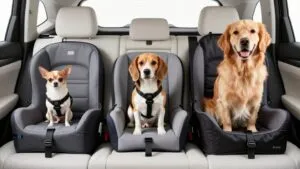
Dog Car Barrier Size Guide: Height and Width by Vehicle Type

Measure your cargo opening at the barrier’s actual mounting points, including trim bulges and side gaps, then compare it with the manufacturer’s usable installed-width range and required panel overlap.
Check seatback-to-headliner clearance at the center and sides, subtracting space for pads and hardware.
Compact cars often span 35 to 45 inches; midsize vehicles 42 to 52; full-size SUVs 56 to 66+.
Use approved anchors, keep clear of curtain airbags and hatch struts, and verify a secure, no-rattle fit.
Vehicle-specific checks follow.
Narrowest Cargo-Opening Measurement
Measure the cargo opening at its narrowest usable point, not just at the widest point between interior panels, before choosing a dog car barrier. Use a rigid tape where barrier sits, checking trim bulges, wheel-arch intrusions, latch housings, and side-panel contours. Record the smallest clear width with seats positioned for travel. Then compare that dimension with the manufacturer’s stated installed-width range, not its maximum advertised span.
Leave adjustment for clamps, panel angles, and secure engagement; don’t force a barrier against plastic trim or rely on compression alone. In compact cars, openings may fall near 35 to 45 inches, while full-size SUVs, vans, and trucks often need 56 to 66 inches or more. Verify folding seats, cargo covers, and tailgate operation won’t obstruct fit. For forceful dogs, choose secure, rigid mounting.
Seatback-to-Headliner Clearance Chart
Seatback-to-headliner clearance determines whether a tall or pressure-mounted dog barrier can install securely without stressing the roof liner or seat structure. Measure at the centerline and both sides with seats folded and upright; record headrests, lights, rails, and any headliner sag. Subtract 10 to 25 mm (0.4 to 1.0 in) for mounting pads, then follow the barrier maker’s stated height limits.
| Vehicle type | Typical folded clearance |
|---|---|
| Small hatchback | 50 to 140 mm (2.0 to 5.5 in) |
| Compact wagon | 80 to 160 mm (3.1 to 6.3 in) |
| Small SUV | 100 to 220 mm (3.9 to 8.7 in) |
Low clearances can rule out vertical pressure poles, especially in subcompacts. Don’t force feet against trim or dome lights. For tall panels, confirm stable contact on approved surfaces, recheck after seat changes, and choose headrest-mounted or low-profile equipment when space is limited. For highly active dogs, use rigid, vehicle-compatible anchors.
Barrier Panel Overlap Allowance
Once vertical clearance checks out, account for panel overlap when sizing an adjustable or multi-panel dog barrier. The advertised maximum width may assume panels are fully extended, yet a safe installation needs enough overlap for locks, clamps, hinges, or telescoping sections to engage as designed. Measure the opening at mounting height, then compare it with the manufacturer’s usable adjustment range, not only its span.
Don’t force panels to their end stops or reduce overlap to close a side gap. Maintain the minimum engagement specified in the instructions, tighten hardware, and confirm that side panels sit securely against contact points. Check for pinch points, interference with seat releases, and movement under pressure. For dogs, favor overlap and rigid mounting; recheck fit after seat adjustments or cargo changes.
Sedan, SUV, and Wagon Ranges
Your sedan may need a 42 to 52-inch barrier, while an SUV often requires greater height and a wagon’s cargo width can vary with seat position. Choose an adjustable barrier only when its certified range safely covers your measured mounting points. Measure width, vertical clearance, and anchor locations before you buy to guarantee a secure fit.
Sedan Width Ranges
For most midsize sedans and small SUVs, choose a barrier that adjusts across roughly 42 to 52 inches, but measure the interior width at the exact mounting point before buying.
In compact sedans, many openings fall near 35 to 45 inches, while broader full-size sedan rear-seat spans may need approximately 45 to 55 inches. Measure straight across between the actual attachment points, not door-to-door or trim-to-trim width. Account for curved seatbacks, center armrests, child-seat hardware, and side-panel angles, which can reduce usable span.
Select a barrier whose stated adjustment range covers your measurement without forcing the frame outward. Confirm that its mounts engage securely with your headrests or approved anchors, and follow the maker’s vehicle-fit instructions. After installation, check for gaps, flex, and interference before every trip with your dog.
SUV Height Requirements
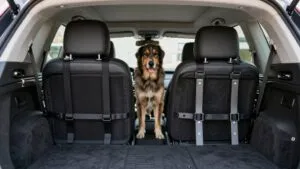
Although width determines basic coverage, barrier height is just as important in SUVs because their taller cabins give dogs more room to climb or jump. Measure from the rear seatback or cargo floor to your intended upper anchor, not simply to the roofline. Most SUV installations need a mid-height 15 to 26-inch barrier behind rear seats; large, athletic, or escape-prone dogs often need roof-reaching coverage or a rigid floor-to-ceiling partition.
Choose steel mesh when your dog leans or pushes, and verify every strap, headrest post, or vehicle-approved anchor is compatible. Leave no climb-through gap at the top or sides. A net can span cabin height, but it shouldn’t replace rigid containment for powerful dogs. Recheck fit after adjusting seat recline or headrests. Follow manufacturer load limits.
Wagon Cargo Dimensions
Wagon cargo openings vary more than exterior size suggests, so measure the interior at the exact barrier location before choosing a model. Sedans usually provide narrower rear-seat spans, often about 42 to 52 inches, while small SUVs commonly occupy a similar range.
Wagons can span roughly 35 to 61 inches because wheel-arch intrusion, sloped glass, and seatback geometry change usable width. Measure at the floor and again at the planned panel height; the narrowest safe span governs.
Check vertical clearance from cargo floor or seatback to the intended upper support. Low cargo lips may suit 12 to 16-inch barriers, whereas larger dogs need rigid, taller containment. For reference, full-size SUVs and vans often need 56 to 66+ inches. Confirm the barrier won’t block seat latches, cargo access, or required rearward visibility during travel.
Adjustable Barrier Fit
Adjustable barriers can fit many vehicles, but you must match the product’s usable range to the width at its actual mounting points. For sedans, adjustable panels commonly cover roughly 42 to 52 inches; compact-car models may begin near 35 inches. Small and midsize SUVs suit the same ranges, while full-size SUVs need wide systems rated around 56 to 66 inches or more. Wagons and hatchbacks can fall anywhere from 35 to 61 inches, because cargo openings, seatbacks, and side contours vary.
Don’t treat a universal-fit claim as a safety rating. Use only barriers whose range permits secure, fully engaged mounts without forcing side panels or leaving gaps. Choose rigid mesh and anchors for active or multiple dogs. Follow manufacturer compatibility limits; don’t obstruct required restraints, seat operation, or emergency access.
Measuring Your Vehicle
Start by measuring the exact opening where you’ll mount the barrier, not the vehicle’s exterior size or a generic model category. Measure width at the headrest posts, seatbacks, or cargo-floor anchors you’ll use, then measure vertical clearance to the roof, headrest, or upper anchor. Record the narrowest point, including trim, wheel wells, and angled side panels.
As a check, compact sedans need 35 to 45 inches; midsize sedans and small SUVs, 42 to 52 inches; and full-size SUVs require 56 to 66 inches or more. Wagons and hatchbacks can range from 35 to 61 inches, depending on seat position. Compare your figures with the manufacturer’s adjustment range, allowing room for secure attachment. Confirm headrest compatibility and test fit with seats folded if you reconfigure cargo space. Choose rigid mounting for large or determined dogs.
Match Barrier to Anchor Points
Before choosing a barrier size, identify the vehicle’s actual anchor points—headrest posts, roof handles, seatbacks, cargo-floor mounts, or factory partition points. Your barrier must attach only to locations its manufacturer approves; don’t improvise with trim, child-seat hardware, or weak hooks. Match headrest-mounted panels to post spacing and confirm the headrests lock securely in their normal positions. For strap systems, verify each attachment can maintain even tension without twisting the barrier or reducing its stated width range.
Choose cargo barriers for dedicated floor mounts, seatback fittings, or factory partition points. Confirm brackets and fasteners follow manufacturer instructions and vehicle-manual restrictions. Measure between anchors, not across the opening, and allow adjustment for clamps and side wings. Pull after installation; it shouldn’t shift, sag, or leave bypass gaps.
Side-Curtain Airbag Clearance
Side-curtain airbags deploy from the roof rail and upper side areas, so keep every barrier strap, bracket, hook, and side panel out of their marked deployment zones.
Check your owner’s manual and airbag labels before selecting attachment points. Don’t loop straps around grab handles, roof rails, trim, or pillars unless manufacturer approves that location. Choose a barrier that reaches its height using lower anchors such as headrest posts, seat frames, or cargo points.
After installation, confirm panels don’t bow toward side glass or interfere with trim. Keep adjustment hardware clear throughout its travel, including when seats fold. If instructions conflict or airbag coverage is unclear, don’t install the barrier there; obtain vehicle-specific guidance. A secure fit must never compromise supplemental restraint system proper operation.
Two-Dog Crate Setups
When transporting two dogs in separate crates, measure the cargo area at the crates’ widest and tallest points—not just at the opening—to confirm both units fit without forcing them against trim, seatbacks, or each other. Leave clearance for crate doors, ventilation openings, emergency-release access, and the barrier’s mounting path. Position the barrier behind the crates only if its anchors and usable height still match the vehicle’s mounting locations.
A rigid partition should span the loaded width, including crate handles or protruding corners, while avoiding interference with hatch operation, seat latches, and airbags. Check each crate manufacturer’s travel instructions and secure each crate independently to designated vehicle tie-down points when permitted. Don’t rely on the barrier to restrain crates during sudden braking or a collision. Before every trip, verify that neither crate can slide, tip, block visibility, or prevent access to essential safety equipment.
Fixing Rattling Barrier Clamps
A rattling barrier clamp usually signals lost tension, poor fitment, or contact with trim, so stop and inspect it before carrying your dog. Park on level ground, unload the cargo area, and check that each clamp sits squarely on its approved mounting point. Follow the barrier maker’s torque and adjustment instructions; overtightening can deform trim, threads, or clamp pads. Recenter the panel, then test it firmly by hand. It shouldn’t shift, buzz, or leave gaps that your dog could exploit.
- Clean clamp pads and mounting surfaces; grit can prevent full contact.
- Replace worn rubber sleeves, stripped fasteners, or bent hardware with manufacturer-approved parts.
- Recheck tension after a short drive, and stop using the barrier if noise returns or clamps move at all under load.
Rear Hatch Strut Clearance
Before installing a cargo-area barrier, check rear hatch strut clearance through the hatch’s full opening arc. Gas struts sweep inward and can contact wide panels, side wings, brackets, or loose straps before the hatch reaches its designed stop. Measure the gap on both sides with the barrier positioned at its intended height and width.
- Keep hardware clear of each strut’s cylinder, rod, and pivot path.
- Open and close the hatch slowly; stop if anything rubs, pinches, or bends.
- Follow the barrier maker’s vehicle-fit instructions and don’t relocate factory strut mounts.
Leave enough space for cargo trim flex and hatch seals. A barrier must stay secure without restricting lift support or emergency access. Recheck clearance after adjusting width, folding seats, or loading gear near it.
Conclusion
Measure your narrowest cargo opening, seatback-to-headliner clearance, and anchor-point spacing before you choose a barrier. Confirm panel overlap, hatch-strut travel, and side-curtain airbag clearance so the barrier can’t shift or interfere with safety systems. Match its height and width to your sedan, SUV, or wagon, especially with two crates. Tighten clamps, eliminate rattles, and recheck fit after installation.
You’ll get safer containment only when the barrier meets vehicle-specific instructions and applicable standards for secure use.
Road Trip Stop & Water Planner
Turn your drive time and your vet-advised stop interval into a stop schedule, a total water amount and a bottle count. Arithmetic only.
Dog Car Harness Size Chart & Fit Finder
Enter your dog's chest girth and weight to see the matching Ruffwear, EzyDog and Sleepypod car harness size, with between-size and crash-test notes.
Airline In-Cabin Dog Size & Carrier Eligibility Checker
Check your dog carrier against Delta, American, Southwest or JetBlue published in-cabin size limits and see if a cargo option exists.