Dog Ramp vs Stairs for the Car: Which Is Easier on Your Dog’s Joints?
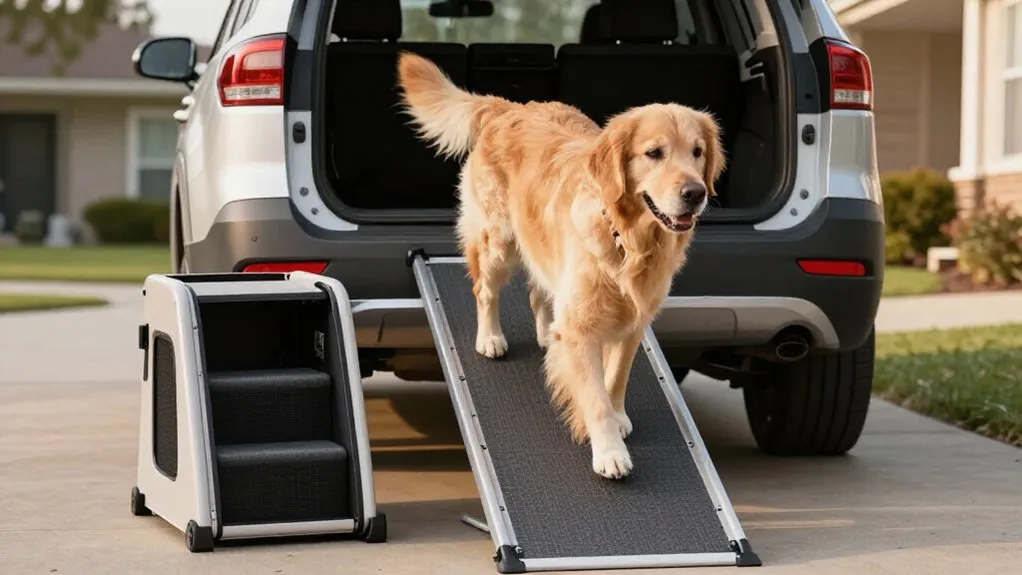
For dogs, you’ll protect joints better with a stable, non-slip ramp than with stairs. A ramp provides continuous weight transfer and reduces peak forces that stairs place on hips, stifles, shoulders, and spine, especially during descent.
Choose a ramp long enough to stay at 20° or less, with secure attachment and dry traction. Stairs may suit small, pain-free dogs with shallow risers and deep treads. Use the guidance ahead to match equipment to mobility needs.
Joint Impact by Dog Size
Ramps generally place less peak stress on a dog’s joints than car stairs because they allow continuous weight transfer rather than repeated vertical step-ups and impact-heavy descents. This pattern lowers impulsive loading on cartilage and reduces repetitive compression at the hips, stifles, shoulders, and spine. Your dog’s mass determines the clinical consequence: larger bodies generate greater joint reaction forces with each stair contact.
| Size | Joint impact |
|---|---|
| Small | Ramps protect joints; stairs may suit healthy dogs |
| Medium | Ramps reduce hip and stifle loading |
| Large | Ramps limit high joint impulses |
| Giant | Ramps provide essential protection |
If your dog has osteoarthritis, cruciate disease, hip dysplasia, spinal disease, or postoperative restrictions, choose a ramp. Healthy large dogs also benefit from fewer high-force loading cycles during routine car access.
Ramp Incline and Step Geometry
If stairs are your only option, select low risers, deep treads, a non-slip surface, and a stable base. These features reduce abrupt vertical displacement and help your dog place each paw. Avoid steep steps: descent concentrates joint loads on shoulders, elbows, hips, and knees.
Vehicle Entry Success Rates
Vehicle-entry success depends on more than the device itself: your dog must perceive the surface as stable, secure, and physically manageable. For arthritic or spinally painful dogs, a gently inclined, non-slip ramp usually supports more consistent entry because it limits painful peak loading and avoids repeated vertical steps.
However, a ramp that feels unstable, slippery, or overly steep can trigger refusal, hesitation, or compensatory muscle bracing. Healthy small dogs familiar with household stairs may enter using shallow, deep-tread steps, but descent can still increase forelimb impact. Measure success as calm voluntary use without slipping, pausing, hopping, or post-entry stiffness. Gradual rewards and lead guidance improve adoption; ramp acceptance averages about nine sessions. If avoidance persists, reassess traction, angle, stability, and pain with your veterinarian.
Fold-and-Stow Setup Time
A fold-and-stow ramp can make low-impact car access practical only when you can deploy it quickly, secure it firmly, and store it without excessive lifting. Before travel, time yourself opening, extending, locking, and refolding it. A device you can manage consistently reduces the chance that you’ll skip it and let your dog jump, which produces higher peak joint loading than a suitably angled ramp. Choose a model with a carry handle, reliable locks, and a weight rating above your dog’s measured mass. Practice the sequence at home so your dog encounters a stable surface every time.
- You’ll feel relief knowing painful joints avoid another abrupt landing.
- Your dog gains confidence when the ramp doesn’t wobble or delay.
- Routine protects mobility when fatigue tempts shortcuts.
Rear Hatch Clearance Requirements
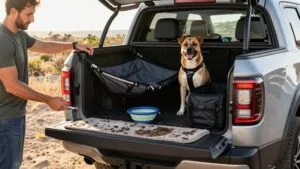
Before choosing a ramp, measure the open rear hatch clearance, tailgate height, and unobstructed ground space behind your vehicle. Allow enough vertical room for the ramp’s attachment lip and for your dog to step through the opening without ducking, twisting, or striking the hatch. Then measure the tailgate height from pavement to loading edge; this rise determines the minimum ramp length needed to hold a joint-sparing slope.
For arthritic, geriatric, large-breed, or spinal patients, aim for no more than 20°; steeper approaches increase limb muscle demand and spinal flexion. Confirm that the ramp reaches firm, level ground without blocking traffic space or forcing an abrupt approach. If clearance is limited, don’t shorten the ramp to fit; reassess parking position or use a safer alternative.
Replacement Grip Costs
Replacement grip costs matter because worn tread can turn a joint-sparing ramp into a slipping hazard that increases compensatory loading on painful hips, knees, shoulders, and the spine. Budget for manufacturer-approved carpet, rubber, or traction tape before it becomes smooth, peeling, compressed, or contaminated. Reliable grip supports controlled weight transfer and prevents abrupt slips that can spike joint moments during descent.
- You’ll protect hard-won comfort after orthopedic treatment.
- You’ll avoid the heartbreak of a painful slip at the car.
- You’ll preserve the ramp’s lower-impact benefit for vulnerable joints.
Compare replacement price, shipping, adhesive needs, and full-surface coverage. Partial patches can leave low-traction zones. Inspect tread routinely; replace it when cleaning no longer restores traction, and secure new material without raised edges during vehicle loading.
Balance Challenges for Senior Dogs
Senior dogs often lose proprioception, limb strength, and postural control, so car-access equipment must reduce both joint loading and fall risk. If your dog sways or needs several attempts to turn, stairs create separate balance tasks. Each step requires limb lifting, riser clearance, deceleration, and regained stability. This can amplify asymmetric loading through painful hips, stifles, shoulders, and the spine.
A stable, gently angled ramp permits continuous weight transfer and fewer abrupt postural corrections. Choose one long enough to remain at or below a 20-degree incline, with a rigid frame and secure vehicle attachment. Shallow, deep-tread stairs may suit a small, agile dog, but don’t use them when weakness, neurologic deficits, or arthritis impair controlled stepping. Introduce the device gradually; consult your veterinarian after falls.
Traction in Wet Conditions
In rain, you need a ramp with a continuous, high-traction surface to limit slips that can abruptly overload your dog’s joints. Wet stair treads can reduce paw grip at each rise and descent, increasing compensatory loading on the shoulders, hips, and spine. Check both surfaces for secure non-slip material and stability before your dog uses them.
Ramp Grip in Rain
- Protect sore joints.
- Preserve trust.
- Prevent fear.
Stair Safety When Wet
When car-entry stairs get wet, reduced tread friction can make a dog slip and abruptly overload the hips, knees, shoulders, and spine. You should treat rain, dew, and slush as a temporary contraindication to stair use, especially if your dog has osteoarthritis, cruciate disease, hip dysplasia, neurologic weakness, or spinal disease.
A slip during descent shifts load forward and can amplify braking forces through the forelimbs and shoulders; a misstep on ascent can twist the knee or hip. Before each use, wipe every tread, inspect for pooled water, and confirm the stairs can’t wobble or slide. Use deep, rubberized treads and a stable base, but don’t rely on traction alone. If surfaces remain wet or your dog hesitates, choose a dry, non-slip ramp instead.
Multi-Dog Household Fit
In a multi-dog household, you should match car-access support to each dog’s size, gait, joint health, and spinal risk. A shared ramp with an adjustable, non-slip incline can reduce peak loading for heavier, arthritic, or mobility-limited dogs, while healthy small dogs may tolerate shallow steps. Choose equipment with a weight capacity above your heaviest dog’s measured body mass and stable locks for repeated shared use.
Matching Access Needs
Choose car access equipment around the dog in your household with the greatest mobility limitation, not the most agile one. A ramp usually fits mixed households best when one dog has osteoarthritis, cruciate disease, hip dysplasia, spinal disease, postoperative restrictions, or advanced age. Its continuous incline lowers peak impact and avoids repeated vertical stepping, protecting vulnerable forelimbs, hips, and spine. Select enough length to keep the slope at or below 20°, with nonslip traction and a capacity above your heaviest dog’s measured weight.
- Let your older dog enter without the sharp hesitation that can signal pain.
- Protect the large dog whose mass magnifies joint reaction forces.
- Preserve every dog’s confidence with stable, predictable footing during car access.
Even healthy companions can use it comfortably.
Although one dog may need assistance more than the others, a shared car-access device should safely accommodate every dog’s size, gait, and confidence level. Prioritize the household member with the greatest orthopedic or neurologic vulnerability; that choice usually protects healthier dogs as well. A ramp with secure traction allows continuous weight transfer and avoids the repeated impact peaks of stair descent, which can load forelimbs and arthritic joints.
Observe each dog separately during entry and exit. Hesitation, shortened strides, toe slipping, refusal, or rushing indicate that the setup isn’t safe for that dog. Prevent crowding: send one dog at a time and keep others clear until the first dog reaches stable ground. This reduces collisions, abrupt turns, and compensatory loading on their vulnerable joints.
Choosing Adjustable Equipment
Adjustable equipment helps you fit one car-access solution to dogs with different body sizes, limb lengths, and orthopedic needs. Choose a telescoping ramp that lets you lengthen the approach for a slope of 20° or less, especially for an arthritic, geriatric, large-breed, or IVDD-prone dog. A shallower incline supports continuous weight transfer and limits peak forelimb impact, hip compression, and spinal flexion. Confirm that locks, hinges, traction, and weight capacity safely accommodate your heaviest dog; capacity should exceed measured body mass. For a healthy dog, convertible steps may work, but use low risers and deep, non-slip treads.
- You’ll protect your senior’s joints from repeated impact.
- You’ll give your long-backed dog a steadier, frightening climb.
- You’ll let dogs enter confidently, without jumping.
Best Choice by Arthritis Stage
As arthritis advances, a ramp becomes increasingly preferable because it avoids the repeated vertical stepping and concentrated joint loading associated with stair descent. With early, mild osteoarthritis, you may use low-rise, deep-tread stairs if your dog remains pain-free, steady, and willing; however, a ramp still limits peak loading. In moderate disease, choose a stable, nonslip ramp set at 20 degrees or less.
Continuous weight transfer reduces abrupt forelimb impact during descent and repeated compressive cycles at hips, stifles, and shoulders. For severe arthritis, weakness, cruciate disease, or spinal involvement, use a ramp exclusively when possible and provide guided, slow access. Stop if you see hesitation, slipping, altered gait, or post-trip stiffness. You’ll need veterinary guidance for your dog’s pain control, mobility, and body weight.
Conclusion
Choose the access aid that lets your dog enter the car with the least joint load, instability, and hesitation. Ramps usually reduce peak flexion and impact, especially for large, arthritic, or balance-impaired dogs, if the incline is shallow and surface stays dry and grippy. Stairs may suit agile smaller dogs when hatch clearance, storage, and rapid setup matter. Test each option at your vehicle, monitor confidence, and ask your veterinarian about worsening pain or weakness.