How Long Should a Dog Ramp Be for an SUV? Measure Before You Buy
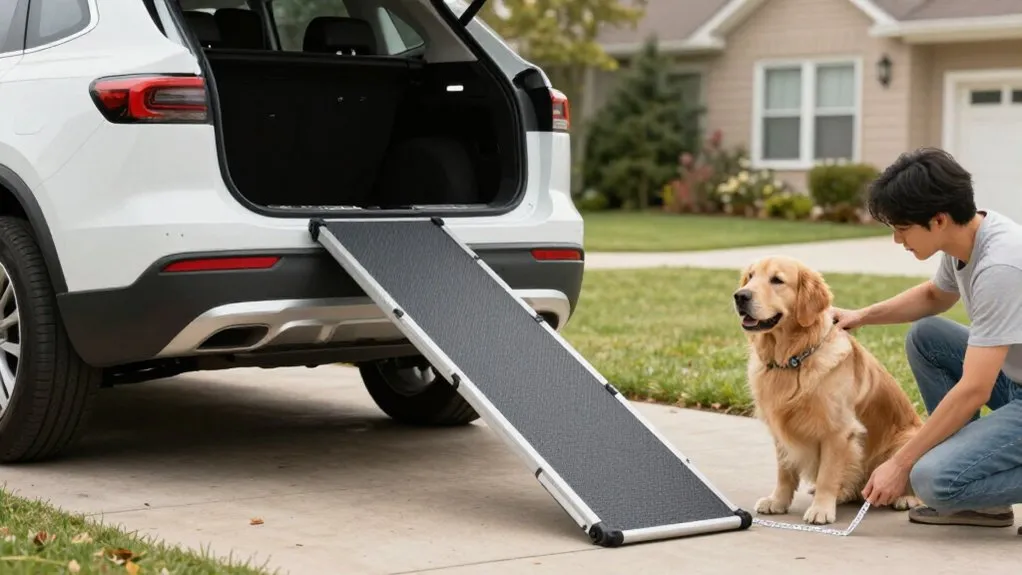
Measure your SUV’s cargo-floor lip height and narrowest usable opening before buying. Choose a ramp long enough to keep the incline at or below 25°; aim for 18° or less if your dog is senior, arthritic, small, or unsteady.
For example, a 28-inch rise needs about 66 inches at 25° or 91 inches at 18°. Confirm level run, secure sill contact, ramp capacity, traction, and locked hinges.
The guidance ahead covers mobility, weather, and safe loading practices.
Measure Hatch Height First
Before choosing a dog ramp, measure the vertical distance from the ground to your SUV’s cargo-floor entry point. Use a tape measure at the actual parking spot, with the vehicle in its usual condition. Measure straight up from firm ground to the cargo-floor lip where your dog steps, not the bumper or hatch opening. Typical SUV heights, often 28 to 30 inches, aren’t a substitute for your result.
Tire pressure, payload, slope, running boards, lift kits, and trailer hardware can change the effective entry height. Record low and high readings if you use multiple vehicles or surfaces. Recheck after loading heavy gear; suspension compression may lower the floor. Accurate measurements help you select equipment that reaches the cargo floor safely, reliably in daily use.
Ramp Lengths by Incline Angle
Ramp length depends on both your SUV’s measured hatch height and the incline your dog can safely manage. Keep general-use ramps at or below 25°; choose 18° or less for senior, arthritic, small, or postoperative dogs. A lower angle requires a longer ramp, but reduces climbing demand and slipping risk. Use the measured vertical height to select a product; don’t assume a standard folding ramp is necessarily adequate.
| Hatch height | 25° length | 18° length |
|---|---|---|
| 24 in | 57 in | 78 in |
| 28 in | 66 in | 91 in |
For a 32-inch opening, you need 76 inches at 25° or 103 inches at 18°. Verify usable ramp length. Reassess if your dog hesitates, slips, or shows pain. Seek veterinary guidance promptly after surgery or with joint disease.
Rise, Run, and Slope Ratio
Angle tables become more useful when you understand the ramp’s rise, run, and slope ratio. Rise is the vertical distance from ground to the cargo-floor entry; run is the horizontal ground distance from the bumper to the ramp’s foot. A 1:3 slope ratio means each inch of rise needs three inches of run. This ratio produces a shallower, more stable approach than 1:2.
For a 30-inch rise, a 1:3 layout needs about 90 inches of run; the ramp’s actual deck length will be slightly longer because it spans the diagonal. Measure rise at the parked vehicle and confirm that the available run stays level and unobstructed. If you can’t obtain adequate run, don’t accept a steeper setup for a dog with joint limitations instead.
Ramp Weight Capacity Ratings
Check the manufacturer’s weight rating and choose a ramp that exceeds your dog’s body weight, plus any carried gear. You should allow a safety margin because stepping, stopping, and shifting weight create dynamic loads above static weight. Inspect materials, hinges, and tread regularly, since wear can reduce the ramp’s reliable capacity.
Understanding Weight Capacity Ratings
A ramp’s weight rating should exceed your dog’s body weight and any gear they may wear or carry, rather than merely matching it. This margin accounts for dynamic forces created when your dog steps, pauses, turns, or accelerates on the incline. Check the manufacturer’s stated maximum load, and confirm whether it applies to a fully extended ramp, because telescoping designs may have different limits at different lengths.
Don’t assume a rating guarantees safety: it depends on intact hinges, locking mechanisms, support feet, and a secure connection to the SUV’s cargo sill. Review the manual for restrictions involving uneven ground, wet conditions, or one-sided loading. Inspect the ramp before use for cracks, loosened fasteners, rails, and worn tread. Replace damaged equipment rather than relying on a capacity.
Matching Dog And Ramp
Weight capacity is only one part of matching a ramp to your dog: the ramp must also provide a stable, appropriately sized walking surface. Choose a model with a rated capacity above your dog’s body weight and any equipment you use, such as a harness. Do not treat a rating as proof of suitability.
Verify that the ramp’s width supports your dog’s natural stance; large or hesitant dogs need 18 to 20-inch or wider surfaces. Use raised edges or side rails when they improve paw guidance. Confirm that the top contact point grips the SUV’s cargo sill, and inspect hinges, feet, tread, and fasteners before every use. A veterinarian can help you select a suitable ramp if your dog has orthopedic disease, poor balance, or impaired mobility.
Accounting For Dynamic Loads
Ramp capacity must exceed your dog’s body weight because climbing creates shifting, concentrated forces beyond a static standing load. Walking changes paw placement and transfers force from one limb to another, especially when your dog accelerates, pauses, or turns near the cargo sill. Treat the manufacturer’s stated capacity as a limit for the complete ramp system, not merely its deck.
Verify that the rating applies at the ramp’s intended extension and configuration; telescoping sections, hinges, locks, and vehicle-contact points can govern performance. Include any equipment your dog wears or carries, such as a harness or medical support. Don’t use a ramp with cracked rails, loose fasteners, worn tread, or damaged locks; these defects can reduce its ability to resist loading during climbing and descent.
Considering Safety Margins
Choose a ramp rated well above your dog’s actual weight, because climbing concentrates force on individual paws and stresses hinges, rails, and attachment points. Treat the manufacturer’s capacity as a maximum limit, not a target. Add your dog’s heaviest expected body weight, including seasonal weight gain, a harness, or carried equipment, then select the next higher rating. For a 100-pound dog, a 200-pound or greater rating provides a conservative reserve; giant breeds may warrant heavy-duty models rated near 400 pounds.
Confirm that the stated rating applies to the ramp’s fully extended configuration and intended vehicle-loading position. Follow limits on single-user loading, placement, and support contact. Don’t allow people or multiple dogs on the ramp unless its instructions explicitly permit that use safely.
Checking Material Durability
Material durability determines whether a ramp can safely sustain repeated loading at its rated capacity without flexing, cracking, or developing unstable hinges. Treat the published rating as a maximum, not a routine operating target. Choose a ramp rated well above your dog’s body weight and any gear or assistance loads.
Manufacturers’ ratings may reflect static testing, whereas a dog’s movement creates shifting forces at the deck, attachment point, and hinges. Examine aluminum rails, plastic panels, fasteners, locking mechanisms, and underside supports for deformation or corrosion. Before each use, verify that hinges lock fully and the anti-slip surface remains securely bonded.
Retire the ramp if you find cracks, looseness, excessive flex, worn tread, or damaged feet. Don’t exceed rating briefly; wet surfaces and poor footing increase fall risk.
Adjust Slope for Arthritis
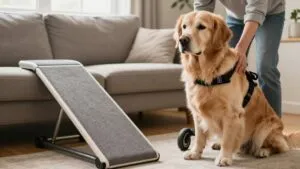
For a dog with arthritis, keep the ramp slope as shallow as practical—ideally about 12 to 20 degrees—to reduce joint loading and improve traction. Measure your SUV’s cargo-floor height, then select enough ramp length to maintain that angle at the parking location. A longer ramp lowers the climbing demand on painful hips, knees, elbows, and spine and can reduce hesitation during entry.
Avoid relying on a short ramp that creates a steep ascent; angles above roughly 30 degrees increase the likelihood that a mobility-impaired dog will refuse, lose balance, or overstrain affected joints. Confirm that the ramp seats securely against the cargo sill and remains stable under your dog’s weight. If not, ask your veterinarian whether a support harness or assisted lifting is safer.
Avoid Icy Ramp Surfaces
Cold, wet conditions can make even a properly angled ramp unsafe. Ice, frost, slush, and freezing rain reduce traction and increase the risk of paw slips, falls, and sudden joint loading. Before each use, inspect the walking surface, ground contact points, and attachment at the cargo sill. Remove snow and ice with a brush or scraper; don’t use de-icing chemicals that may irritate paws or leave slick residue.
Dry the tread completely, then confirm that its textured, non-slip material remains exposed and intact. If temperatures are near freezing, assume runoff can refreeze during loading. Park where you can limit meltwater and use a dry, level approach. Postpone ramp use whenever you can’t restore traction. Carry your dog or wait until conditions improve.
Loading a Labrador Retriever
A Labrador Retriever’s size, weight, and enthusiasm make controlled ramp loading essential. Before each trip, assess your dog’s gait, alertness, and willingness to use the ramp. Healthy adult Labradors often weigh 55 to 80 pounds, so select a ramp rated well above your dog’s body weight.
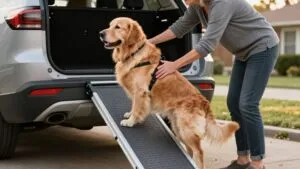
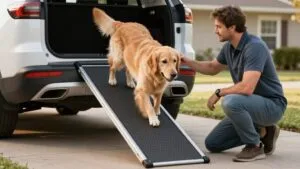
Use a wide, high-traction surface with raised edges to support stable paw placement. Keep your Labrador on a short leash and guide a slow, straight ascent; don’t allow running, jumping, or sudden turns. Reward calm steps rather than pulling your dog upward. Stop immediately if you observe limping, hesitation, slipping, panting unrelated to heat, or reluctance to bear weight. Dogs with arthritis, hip dysplasia, or previous cruciate injury need veterinary guidance and may require a shallower ramp angle.
Check Ramp Hinge Locks
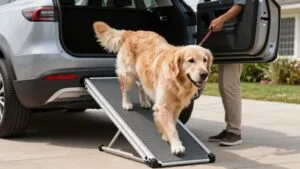
Before each loading session, confirm that every folding-ramp hinge is fully opened, aligned, and positively locked. A partially engaged hinge can shift under your dog’s weight, changing the ramp’s support and increasing fall risk. Follow the manufacturer’s locking sequence; don’t assume visual alignment confirms engagement. Apply light downward pressure near each joint before your dog steps on the surface.
- Listen for the stated click or verify the mechanical indicator, if present.
- Check that pins, latches, and fasteners are free of dirt, corrosion, cracks, and deformation.
- Remove the ramp from service if a lock won’t engage, releases under pressure, or has visible damage.
Never let your dog test an uncertain ramp. Replace damaged components only with manufacturer-approved parts, and reassess the locks after transport carefully.
Measure Cargo Opening Width
After confirming the hinge locks, measure the SUV’s usable cargo-opening width at the narrowest point, accounting for trim, latch hardware, and any protruding bumper features. Use a tape measure with the liftgate fully open and record the clear span where the ramp will rest. Compare that figure with the ramp’s deployed width, not its folded dimensions. Allow enough margin that side rails, paws, and attachment lips don’t contact metal or plastic during loading.
- Confirm both ramp feet sit flat on the cargo floor.
- Keep rails clear of weatherstripping and closing mechanisms.
- Reject a fit that requires twisting, shifting, or partial support.
A centered, fully supported ramp limits lateral movement and reduces fall risk. Recheck the measurement after accessories, liners, or hitch-mounted equipment are installed.
Conclusion
Before you buy, measure your SUV’s hatch height and cargo opening, then choose a ramp length that keeps the incline shallow for your dog’s size, mobility, and confidence. Confirm the manufacturer’s weight rating exceeds your dog’s weight, including dynamic loading. Test hinge locks, traction, and stability on dry ground.
For arthritis, use a longer ramp and lower slope. Don’t use icy or wet surfaces. Supervise every loading session, especially with large dogs, and reduce injury risk.