Soft vs Hard Dog Crate for Car Travel: Comfort, Safety and Portability
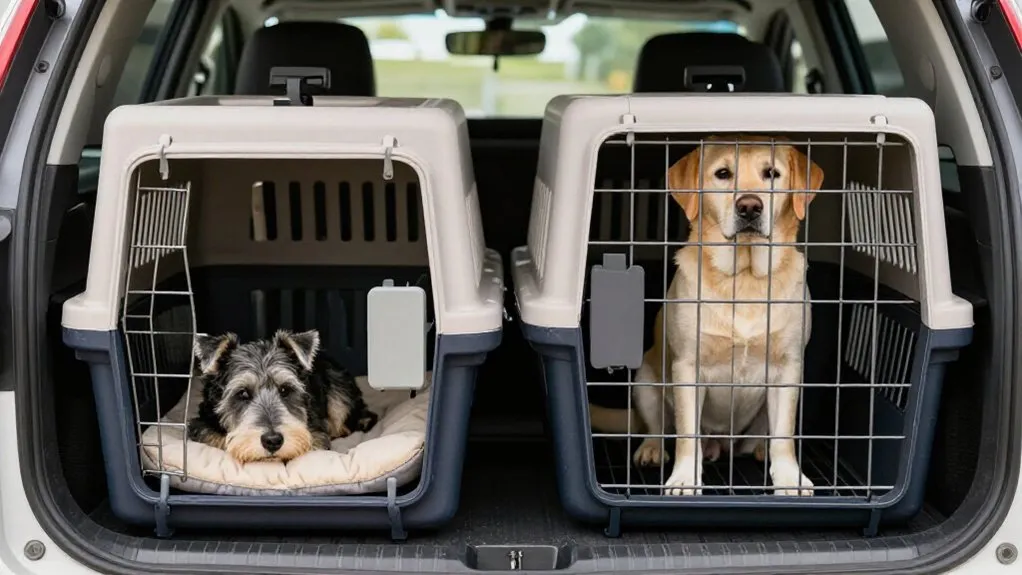
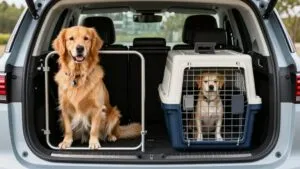
For car travel, choose an independently crash-tested hard crate when safety is your priority: rigid shells better limit movement and resist damage than soft fabric crates.
Give your dog room to stand, turn, and lie down, then secure the crate to approved anchors as its maker directs. Soft crates fold flat for supervised containment, but they can collapse or tear.
Never leave your dog in a sunlit parked car. Next, compare fit, latches, and tie-downs.
Crash Protection vs Fold-Flat Storage
When crash protection is your priority, a rigid hard crate is the safer choice: its shell can hold its shape, distribute impact forces, and better limit your dog’s movement during a collision. Crash-tested hard kennels have outperformed soft, fold-flat crates in CPS protocols; however, only tested models provide that evidence.
| Feature | Hard crate | Soft crate |
|---|---|---|
| Crash response | Holds shape | Can collapse |
| Storage | Fixed footprint | Folds flat |
| Best use | Anchored travel | Supervised stops |
Secure a compatible hard crate to cargo anchors or vehicle hardware, and size it so your dog can stand, turn, and lie down. Heavy crates need more installation effort, but they stay stable. Choose a soft crate for portable, temporary containment—not primary collision protection. Inspect hard crates after any significant crash.
Frame Materials and Construction
Although both styles can contain a dog, their construction determines whether they maintain a protective space during sudden braking or a collision. Hard crates use rigid metal frames or molded hard-plastic shells, such as ABS, to spread forces across the enclosure rather than concentrating them on your dog. Their solid doors, secure latches, and integrated tie-down slots can support dependable vehicle installation when you follow the manufacturer’s instructions.
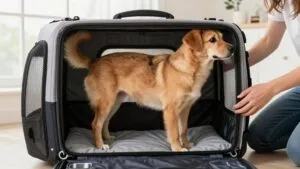
Soft crates rely on nylon fabric, mesh, zippers, and light wire or pole frames. This design improves airflow, visibility, carrying, and storage, but it doesn’t create a load-bearing safety cell. Under substantial force, panels may deform and closures may fail. If crash protection is your priority, choose a tested hard crate sized for standing, turning, lying down.
Highway Vibration and Stability
At highway speeds, a properly secured hard crate keeps its shape and limits sliding, tipping, and uncontrolled movement from vibration, lane changes, or sudden braking. Anchor it to approved vehicle points or use its manufacturer’s specified restraint system; a crate that merely sits in the cargo area can still become a hazard.
Soft crates may dampen some minor road buzz through fabric, but their flexible frames and limited tie-down points can’t reliably prevent shifting or collapse. Check the crate’s fit before every trip: your dog should stand, turn, and lie comfortably without pressing against walls. Place it low and squarely, then inspect straps after initial miles; stop if vibration loosens hardware or causes visible distress. Offer water during regular planned breaks, when appropriate.
One-Handed Door Latch Operation
A one-handed door latch can make loading and unloading safer because you can keep your other hand on your dog, leash, or vehicle for control. Hard crates typically feature secure, spring-loaded latches you can release with a thumb or finger flick, letting you brace the crate or guide your dog simultaneously. Soft crates rely on zippers, which demand both hands and more time, raising the risk of your dog bolting toward traffic during an unsupervised moment.
Quick, single-motion latches also matter in emergencies: if you’re managing an injured or frightened dog, you need instant access without fumbling. When you’re comparing crates, test the latch mechanism yourself—confirm you can open and close it smoothly under one hand before you rely on it streetside, especially near moving vehicles or busy parking areas.
Cargo-Area Tie-Down Point Layout
Cargo-area tie-down points determine whether a crate stays in place during hard braking or a collision. Before choosing a crate, inspect cargo anchors, spacing, and strap-pull direction. Use anchors on both sides, forward and rearward, so it can’t slide, rotate, or tip. Integrated slots on a hard crate usually accept rated straps more securely than fabric loops on a soft crate.
Match the crate footprint to the available anchor layout. Keep straps short, straight, and tight without crushing ventilation panels or blocking doors. Follow the vehicle and crate manufacturers’ load guidance, and check straps, buckles, and anchors before every trip. Position the crate against a stable surface where possible, while preserving airflow and enough room for your dog to stand, turn, and lie down.
Replacement Cover and Zipper Costs
Replacement covers and zipper repairs can make a soft crate economical to maintain, but they don’t restore crash protection if the frame, seams, or closure system has weakened.
Before you spend money, inspect zipper tracks, pulls, fabric panels, stitching, and frame joints. A replacement cover may improve comfort and containment during supervised use, while a professional zipper repair can prevent escapes. However, you shouldn’t treat either fix as a safety upgrade for vehicle travel. Test closures, follow manufacturer guidance, and retire the crate when mesh tears, seams stretch, poles bend, or zippers separate under tension. Compare repair costs with a carrier, but prioritize independently crash-tested, secured containment when you drive. Your dog needs room to stand, turn, and lie down without relying on components.
Heat Buildup in Sunlit Cars
Even on a mild day, direct sun can heat a parked car rapidly, creating dangerous conditions for a dog in either a soft or hard crate. Neither mesh nor hard-shell vents make a parked vehicle safe: cabin temperatures can rise quickly above outdoor levels, and dogs cool themselves less efficiently than people.
- Park only when you can take your dog with you.
- Choose shade, but don’t treat it as reliable protection.
- Use sunshades and reflective covers to reduce radiant heat.
- Check the crate’s location; rear glass can intensify exposure.
- Watch for panting, drooling, weakness, vomiting, or collapse.
If you see signs of overheating, move your dog to a cool area, offer water, and contact a veterinarian immediately; heatstroke is an emergency. Act without delay.
Chew Resistance and Snagging
If your dog chews or paws at confinement, a hard crate’s rigid shell generally resists damage better than fabric, mesh, and zippers. Soft crates can snag on claws or tear at seams, creating escape and injury risks during travel. Check either crate regularly for worn edges, loose threads, or damaged latches that could harm your dog.
Material Chew Resistance
Hard crates generally resist chewing, clawing, and snagging better than soft crates because their rigid plastic or metal shells don’t present fabric seams, mesh, or zippers that a stressed dog can damage. You’ll see this matter most with anxious dogs during travel, when stress chewing spikes and crate integrity becomes a safety issue, not just a durability one. Choosing the right material protects both your dog and your investment:
- Hard plastic (ABS) or metal shells resist teeth and claws far better than nylon panels
- Mesh windows on soft crates tear or puncture under repeated pressure
- Zippers on soft crates can fail, giving anxious dogs an escape route
- Wire-frame soft crates bend under sustained clawing, weakening the structure
- Hard crates hold shape after repeated stress, while soft ones degrade with use
For anxious chewers, you’re safer choosing a hard crate.
Snag Prevention and Tear Risks
Beyond chewing, snags and tears can quickly compromise a soft crate’s containment in a moving car. Mesh can catch on claws, collar tags, seat hardware, or cargo edges; repeated tension weakens stitching and zipper seams. If your dog paws, spins, or shifts during braking, a small puncture can enlarge, exposing them to escape, entanglement, or sudden loss of containment.
Before each trip, inspect fabric, mesh, seams, zippers, and frame joints under good light. Remove dangling tags, keep nails trimmed, and position the crate away from sharp anchors and abrasive trim.
Don’t repair major damage with tape alone; it may fail under load. Replace compromised soft crates, and choose a crash-tested hard crate when you need reliable containment. Choose a size that reduces stress-driven scratching.
Backseat Fit for Large Breeds
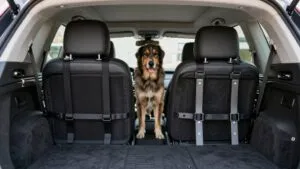
Before you buy a crate for your large breed, measure your backseat‘s width, depth, and height so you know exactly what footprint and clearance you’re working with. Your dog needs enough room to stand, turn, and lie down comfortably, so check the crate’s dimensions against your dog’s size and your vehicle’s space—not just the other way around. Once it fits, secure it tightly with seatbelts, tie-down straps, or anchor points, since even a well-fitted crate can become a hazard if it shifts during a crash.
Measuring Backseat Dimensions
Since large breeds need room to stand, turn, and lie down without folding their legs underneath them, you’ll want to measure your backseat before you buy either crate type. Grab a tape measure and check these key spots:
- Seat width between door panels, since narrow backseats limit crate placement options
- Seat depth from front to back, ensuring the crate sits level without tipping
- Door opening width, confirming the crate clears without forcing or tilting
- Seatbelt anchor locations, essential for securing hard crates against crash forces
- Floor obstructions like center consoles, which can shift crate stability underneath
Record each measurement before shopping. Accurate numbers prevent buying an oversized crate that compromises safety or a cramped one that restricts natural movement, posture, and circulation during travel.
Crate Footprint and Height
Your measurements set the limits; now compare them with the crate’s full footprint and assembled height. Check the manufacturer’s listed length, width, and height against your seat-to-floor space, not just the folded or packed dimensions. Hard crates hold a fixed shape, so their assembled footprint is non-negotiable—measure the exact external dimensions, including latches and vents that add bulk. Soft crates compress somewhat, but don’t assume flexibility solves a sizing problem; a cramped frame still restricts your dog’s ability to stand, turn, and lie down.
For large breeds, prioritize height clearance first, since hunched posture during a drive raises stress and discomfort. If the footprint exceeds your seat area, don’t force a fit; a crate that’s too large for the space compromises stability and your dog’s safety.
Securing Large Breed Crates
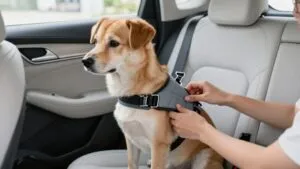
Once a large crate fits the back seat, you still need to anchor it—fit alone won’t stop it from sliding or tipping during a sudden stop. Large dogs create substantial momentum, so use the vehicle’s approved restraint points and the crate maker’s instructions. A soft crate may suit supervised rest stops, but its fabric and zippers rarely provide reliable crash containment. Keep ventilation clear and give your dog room to stand, turn, and lie down.
- Thread seat belts through designated slots; don’t cinch straps over weak panels.
- Use two independent tie-downs to limit forward and sideways movement.
- Check latches, straps, and belt tension before every trip.
- Place it level, away from airbags and loose cargo.
- Stop and reassess if your dog can’t settle comfortably.
Emergency Exit Accessibility
In an emergency, you need to reach and remove your dog quickly without compromising containment during normal driving.
Choose a crate with doors you can open from the vehicle’s accessible side, even if cargo shifts or another door is blocked. Practice the release mechanism before travel, and keep keys, straps, and bedding from obstructing it. Hard crates usually use secure latches that resist impact, but you should confirm you can operate them under stress.
Soft crates may offer top and side openings, yet damaged zippers or collapsed fabric can delay removal. Position the crate so you can access its main door, carry a leash, and don’t force an injured dog through a narrow opening. Call emergency responders for guidance when extraction could worsen injuries.
Conclusion
If you drive often or your dog’s a chewer, climber, or large breed, a hard crate earns its weight: crash-tested protection and real tie-down security matter more than convenience. If you travel occasionally with a calm, smaller dog, a soft crate’s portability and fold-flat storage make more sense. Either way, don’t guess: check for crash-test data, secure every trip with proper tie-downs, and never leave your dog in a parked car. Your choice should protect them, not just contain them.