Are Inflatable Back Seat Extenders Safe for Dogs? Durability and Puncture Risks
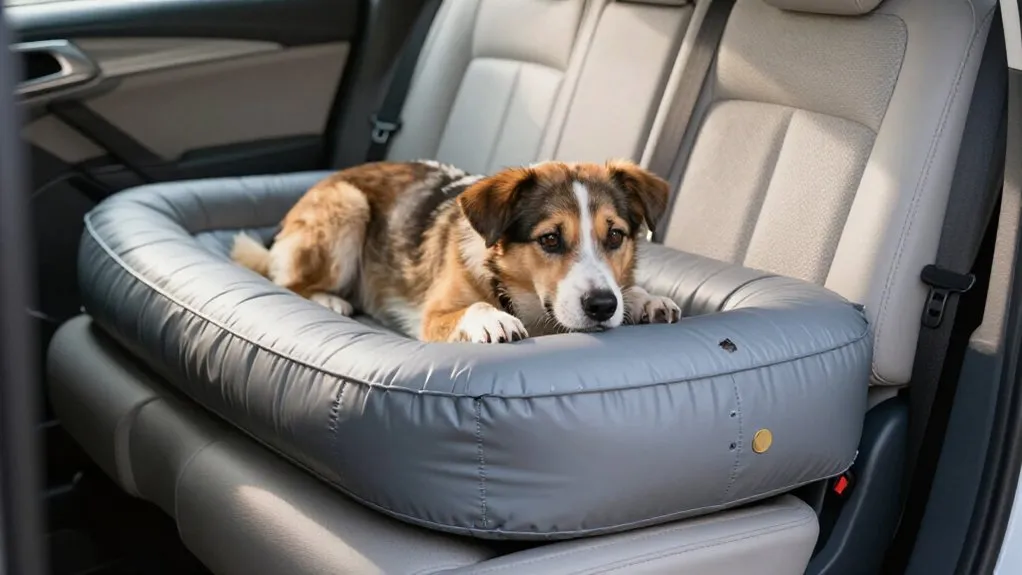
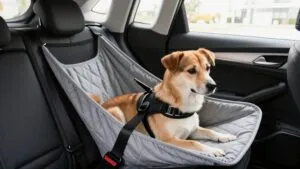
Inflatable back-seat extenders can improve dog footing and fill the footwell, but they aren’t crash restraints and can puncture, leak, bow, or shift during braking.
Choose reinforced seams, abrasion-resistant materials, and separate chambers; trim nails, inspect for leaks, and check firmness after heat changes.
Measure your vehicle’s footwell so edges don’t bend or press on seats.
Use a crash-tested crate or harness, protect airbag zones, and consider rigid support for senior dogs.
Key trade-offs follow.
Safety Depends on Seam Strength
An inflatable back-seat extender is only as safe as its seams, because those joints carry the shifting force created when your dog stands, turns, jumps, or braces during braking. Choose a model with reinforced, welded seams and a stated weight capacity; many inflatable products lack standardized load testing.
You should also match the extender to your vehicle’s footwell depth, seat spacing, and center-console layout. A poor fit bends or stretches the platform at its edges, concentrating force at seam lines. Check inflation before every trip and follow the manufacturer’s pressure guidance: underinflation increases flex, while heat can raise internal pressure and strain joints. Replace the unit if you see seam separation, distortion, or recurrent leaks.
For large, older, or unsteady dogs, consider rigid support.
Puncture Resistance for Dog Claws
Dog claws can puncture an inflatable extender when a sharp nail concentrates force on one small area, especially as your dog stands, turns, or scrabbles for balance. A single hole may leak slowly and leave the surface uneven; a larger cut can deflate it quickly. PVC offers moderate resistance, but sharp nails can cut it, particularly after heat or UV aging. TPU is generally tougher, more flexible, and more abrasion-resistant.
You can’t rely on weight ratings to predict claw resistance: manufacturers rarely publish standardized puncture-force results for these products. Choose reinforced, abrasion-resistant covers and a hard-bottom insert when available, keep nails trimmed, and inspect folds, valve areas, and worn coatings before every trip. Replace leaking or repeatedly patched units to reduce slipping risks.
Highway Braking Stability
During hard highway braking, an inflatable back-seat extender can compress, shift, or deflate enough to let your dog slide forward or drop into the footwell. That instability matters because sudden deceleration transfers your dog’s weight toward the front seats, concentrating force at the extender’s edge and seams.
A soft, underinflated platform may buckle rather than provide predictable support, especially for a large dog, deep footwell, or poorly fitted vehicle setup. It isn’t a restraint and can’t prevent forward motion in a crash. Use a properly sized, crash-tested canine restraint attached as directed by its manufacturer; don’t rely on the extender for impact protection. Before driving, confirm the platform is fully inflated to its specified pressure, seated securely, and level. Add a non-slip surface underneath.
Single-Chamber Versus Multi-Chamber Designs
When you compare designs, a multi-chamber extender can isolate a puncture, whereas a single chamber may deflate across the entire surface.
Separate chambers may also preserve more stable footing during a slow leak, reducing slip and awkward-posture risks. You’ll still need to inspect valves and seams before trips, since multiple chambers add maintenance and repair points.
Puncture Isolation Benefits
Although inflatable back-seat extenders lack standardized puncture testing, multi-chamber designs can offer a meaningful safety advantage over single-chamber models: a puncture may deflate only one section rather than collapsing the entire platform. If your dog’s claw, tag, or buckle breaches one isolated bladder, the remaining sealed compartments may retain air, buying you time to stop safely and prevent a full-surface failure.
This design doesn’t make the extender puncture-proof, and it can’t replace a crash-tested restraint or careful supervision. Slow leaks and seam damage can still compromise the product, while no universal test standard confirms how well a given chamber isolates damage. Before each trip, inspect valves, seams, and covers for abrasion or leaks, and replace units with recurring damage. Keep a patch kit onboard.
Stability Across Chambers
Beyond limiting the effects of a puncture, chamber layout affects how stable the platform feels under your dog’s weight. Single-chamber extenders act as one air volume, so a dog’s step, turn, or landing can shift pressure across the entire surface. If inflation is uneven or the footwell is deep, the platform may bow or roll toward an edge. This instability can make your dog brace abnormally, particularly if it has arthritis, weakness, or poor balance.
Multi-chamber designs divide support into separate air cells, which can reduce broad pressure transfer and limit side-to-side motion. However, chamber seams can create ridges or unequal heights when cells compress differently. You should favor a model that fits rear-seat gap closely and remains level under your dog’s weight.
Repair And Maintenance
Repair needs differ sharply by chamber layout: a single-chamber extender may be simpler to inspect and patch, but one puncture or valve leak can deflate the entire platform and remove support at once. You should inspect seams, valves, and cover-contact areas before each trip, inflating to recommended pressure. Clean grit from valves and dry bladder before storage; debris can impair seals or conceal abrasion.
Multi-chamber models take longer to diagnose because you must isolate each cell, yet intact chambers can preserve partial support after another leaks. Don’t rely on redundancy as crash protection. Apply approved patches to small holes and retest overnight. Replace the extender if a seam separates, a valve leaks, or patches sit in load-bearing corners. Slow leaks strain older dogs’ joints.
Hot-Car Pressure Changes
When a parked car heats up, air inside an inflatable extender expands and raises internal pressure. This added pressure can strain seams and valves, increasing the risk of leakage or sudden failure under your dog’s weight.
Before travel, follow the manufacturer’s guidance and release excess air if needed so the surface remains firm without overinflation.
Heat-Driven Air Expansion
Heat can raise the internal pressure of an inflatable back-seat extender quickly, especially in a parked car where cabin temperatures climb well above outdoor conditions. As trapped air warms, it expands, so a unit filled firm in cool conditions can become overly taut by midday. This can reduce its safety margin and make the platform less predictable for your dog.
| Cabin | What happens | Your action |
|---|---|---|
| Cool | Baseline fill | Check firmness |
| Hot | Air expands | Park shade; recheck |
Don’t leave your dog in a parked vehicle: cabin heat can cause rapid overheating, respiratory distress, and heatstroke. Inflate only to the maker’s recommended level, then reassess firmness after temperature changes. If it feels rigid, release a small amount of air after moving to a safe, shaded location.
Pressure Stress on Seams
As a hot car raises air pressure inside an inflatable extender, its seams and valve joints carry greater tension and may fail, particularly if the unit was already inflated firmly. Heat also exposes adhesive-bonded or welded seams to sustained tensile loading, especially at corners, folds, and points pressed against seat hardware.
If a seam has prior abrasion, manufacturing defects, or early separation, higher internal pressure can enlarge that weakness quickly. A valve seal may likewise leak when its joint distorts under load. You can’t reliably judge seam integrity from appearance alone. Check for bulging, whitening, lifted coating, audible leaks, or loss of firmness before placing your dog on it. Replace any extender with seam damage rather than relying on patches in high-stress areas immediately.
Venting Before Travel
Before driving in warm conditions, check the extender’s firmness and release a small amount of air if it has become overly taut. Heat raises the temperature of trapped air, which can increase internal pressure and place added stress on seams, valves, and weakened areas. Don’t vent it until it feels soft; underinflation allows excessive flexing and can increase slipping or fatigue damage.
Use the manufacturer’s inflation guidance, and recheck the platform after the car has cooled or after long stops in sun. Keep your dog restrained with an appropriate travel harness or crate; the extender isn’t crash protection. If you notice seam bulging, a leaking valve, or uneven support, don’t drive with it. Deflate, inspect, and replace damaged equipment before your next trip when necessary.
Senior Dogs Entering SUVs
For senior dogs entering an SUV, an inflatable back-seat extender can reduce the drop into the footwell after they’re inside, but it doesn’t solve the higher-risk step or jump through the vehicle door. If your dog has arthritis, weakness, reduced vision, or impaired balance, that entry movement can overload painful joints and increase fall risk. Use a stable ramp or appropriately sized steps with a non-slip surface, and support your dog with a well-fitted mobility harness if your veterinarian recommends one. Don’t let your dog leap from uneven ground onto the seat.
Once aboard, check that the extender is fully inflated, level, and secured against shifting. An underinflated or slowly leaking surface can make standing and turning harder, particularly for dogs with hind-limb weakness.
Not Crash-Tested as Restraints
A level, secure extender can improve footing, but it doesn’t restrain your dog or protect them in a crash. Inflatable platforms are designed to fill the footwell and enlarge the resting area, not to manage crash forces. Manufacturers commonly provide no standardized crash-test data for these products, and a stated weight capacity doesn’t establish occupant protection.
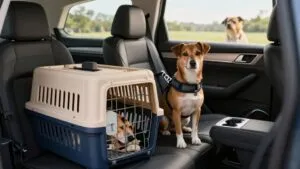
Use a crash-tested travel crate or vehicle-compatible, crash-tested harness, installed as directed. Choose properly sized equipment and follow the restraint and vehicle instructions.
An extender may sit beneath a restraint only if it doesn’t interfere with harness connections, crate stability, or seat-belt routing. Never treat a stable surface as a substitute for restraint: during abrupt braking, turns, or impact, an unrestrained dog can be thrown forward and injured.
Ignoring Side-Airbag Deployment Zones
Although an inflatable back-seat extender can improve footing, it mustn’t block or interfere with your vehicle’s side-airbag deployment zones. Side airbags may deploy from seat-mounted bolsters, door panels, roof rails, or pillars, depending on your vehicle.
An extender that presses against these areas, anchors across marked seams, or encourages a dog to lean there can alter the intended deployment path. During a collision, obstruction may reduce occupant protection. Check your owner’s manual and extender instructions before installation; don’t assume a universal fit is safe.
- Keep all “SRS” or airbag labels, seams, and trim paths uncovered.
- Avoid straps or inflated edges near seat-side bolsters and doors.
- Position your dog away from curtain-airbag coverage areas.
- If compatibility is unclear, ask your dealer or a qualified vehicle technician.
Measure Footwell Width Before Buying
Before buying an inflatable back-seat extender, measure your vehicle’s footwell width, depth, and the distance between the rear-seat edge and front seats. Record the narrowest usable width, rather than assuming a universal fit.
An extender that is too narrow can bow at the edges; one that is too deep may press against front seats or a center console. These mismatches concentrate load on seams and corners, increasing abrasion, shifting, and deflation risk. Compare your figures with the maker’s inflated dimensions and account for seat tracks, floor contours, and console shape. Don’t force the platform into place.
While parked, test it with your dog supervised, checking for sagging, valve contact, or movement. A level surface reduces slipping and awkward joint loading, particularly for older dogs.
Conclusion
Inflatable back-seat extenders can give your dog a more stable travel surface, but you shouldn’t treat one as a safety restraint. Choose thick, multi-chamber construction with reinforced seams, verify footwell fit, and inspect it before every trip for leaks or claw damage. Keep it clear of side-airbag deployment zones, adjust inflation for heat, and help senior dogs enter safely. During braking, use a crash-tested harness or secured crate; extenders only reduce gap and footing risks.